Finished Goods
Back to Blog
Vape Hardware10 min read

Bulk Vape Cartridges Wholesale: A Buyer's Guide for Licensed Cannabis Brands

How licensed cannabis brands source bulk vape cartridges wholesale. MOQs, specs, compliance, and what to verify before placing a bulk wholesale order.

Jul 5, 2026
Bulk Vape Cartridges Wholesale: A Buyer's Guide for Licensed Cannabis Brands

Bulk Vape Cartridges Wholesale: A Buyer's Guide for Licensed Cannabis Brands

Buying bulk vape cartridges wholesale means purchasing empty 510-thread or proprietary-fit cartridges in case quantities (typically 1,000 to 10,000+ units per SKU) from a hardware supplier or brokerage that ships direct to licensed cannabis processors. For licensed brands, the right partner provides documented heavy metals testing, consistent intake diameter and wicking specs, low DOA rates, and lead times that match your fill schedule. Finished Goods brokers cartridge hardware for licensed cannabis brands across multiple states and can match SKUs to viscosity, formulation, and price tier without locking buyers into a single factory.

What "bulk" actually means in cartridge procurement

Bulk pricing tiers in this category usually break at these thresholds:

  • Sample / qualification: 50 to 500 units
  • Small production: 1,000 to 5,000 units
  • Standard wholesale: 10,000 to 50,000 units
  • Container or program pricing: 100,000+ units

Unit cost drops at each tier, but so does flexibility. Buyers who lock a full container of a single SKU give up the ability to test viscosity performance across hardware variants. Most operators running multiple strains or live resin lines order in the 10,000 to 50,000 range per SKU and stagger deliveries.

What to specify when requesting a quote

A usable RFQ for wholesale vape cartridges includes:

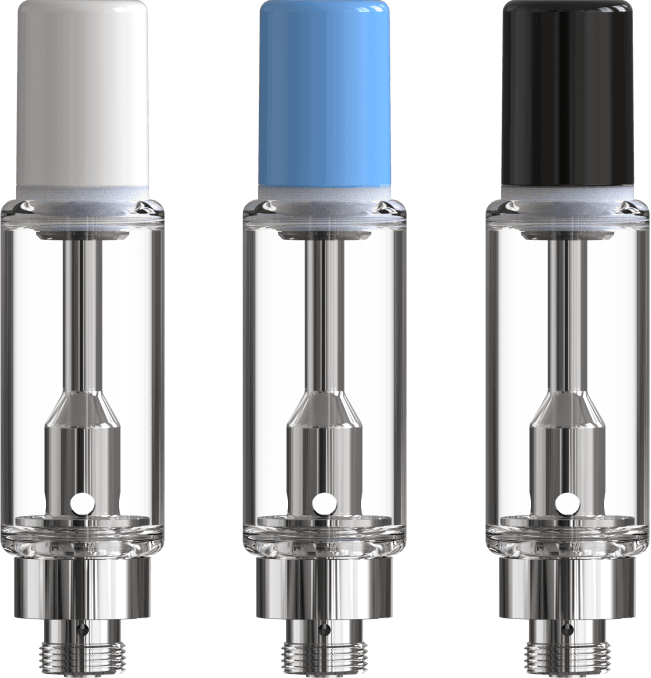
Thread type. 510 thread is standard. Proprietary pod systems require matched batteries.

Capacity. 0.5 mL and 1.0 mL are the volume movers. 0.3 mL and 2.0 mL exist for specific formats.

Intake aperture. Typically 1.2 mm to 2.0 mm. Match to oil viscosity. Live resin and rosin usually need 1.8 mm or larger.

Wick material. Ceramic is dominant. Cotton and polyfill are legacy.

Mouthpiece material. Ceramic, plastic, or metal. Affects regulatory acceptance in some states.

Heating element. Coil-style versus coilless ceramic. Coilless reduces metal contact with oil.

Center post and housing material. Glass tank with stainless or zinc alloy housing is typical.

Compliance documents. Heavy metals COA, FDA-grade material declarations, and Prop 65 status if shipping to California.

Suppliers that cannot provide testing documentation on request should be disqualified before sampling.

How to evaluate a wholesale cartridge supplier

Use these criteria when comparing vendors:

  • Heavy metals testing. Recent third-party COA on the exact SKU and lot.
  • DOA rate. Documented field rate from existing customers.
  • Lead time. Stocked inventory versus production lead time in weeks.
  • MOQ flexibility. Ability to split orders across SKUs or capacities.
  • Customization. Mouthpiece color, ceramic tip options, print and box options.
  • Licensing fit. Willingness to invoice and ship to licensed cannabis entities.
  • Replacement policy. Stated remedy for out-of-spec lots.

Best fit by use case

  • Distillate at standard viscosity: 1.5 mm to 1.6 mm intake, ceramic coil or coilless ceramic, 0.5 mL or 1.0 mL.
  • Live resin and high-terp oils: 1.8 mm to 2.0 mm intake, coilless ceramic preferred, 1.0 mL most common.
  • Rosin and solventless: Largest available intake, post-fill heat recommended, expect higher cure times.
  • Value tier flower-derived distillate: Standard ceramic coil cartridges in 0.5 mL, optimized for price per unit.
  • Premium SKUs and craft brands: Coilless ceramic with custom mouthpiece and printed packaging.

Why work through a brokerage instead of a single factory

Direct-to-factory purchases can lower unit cost on paper, but they create three problems for licensed operators:

Single point of failure. One QC issue or shipping delay stops your fill line.

Limited SKU range. Factories optimize their own catalog and will not recommend a competitor's part even when it fits your oil better.

Import and compliance overhead. Customs, testing verification, and replacement claims fall entirely on the buyer.

A brokerage qualifies multiple factories, holds domestic inventory, handles replacement claims, and matches SKUs to formulation. For brands running more than one oil type, this usually nets out lower than direct sourcing once DOA and downtime are counted.

How Finished Goods handles bulk cartridge orders

Finished Goods works only with licensed cannabis brands and processors. Standard process:

Intake call to confirm oil type, target retail price, and fill equipment.

Sample kit with two to four cartridge variants matched to your viscosity.

Fill and burn testing on your side, with documented results.

Quote with current lead times, COAs, and replacement terms.

Domestic shipping to your licensed facility.

Reorders ship from existing inventory when available, which compresses lead time versus overseas direct.

Common mistakes when buying bulk vape carts

  • Ordering large volume before fill testing the exact SKU with your oil.
  • Accepting COAs that do not match the lot number on the cartons.
  • Choosing intake aperture by price tier instead of viscosity.
  • Skipping mouthpiece material checks in states that restrict certain plastics.
  • Treating cartridge hardware as a commodity when it is the part of the product the consumer actually touches.

Next step

If you are sourcing bulk vape cartridges wholesale and want a supplier that will match hardware to your oil rather than push a single catalog, request a sample kit from Finished Goods. Include your oil type, target capacity, and monthly volume in the request so the kit arrives matched to your actual production.

Understanding Quality Standards When Buying Bulk Vape Cartridges Wholesale

When licensed cannabis brands source bulk vape cartridges wholesale, the most important quality standard to verify is the heavy metals test report, because the cartridge hardware is the only non-consumed part of the product that directly contacts the heated oil during every draw. Suppliers who provide third-party COAs matched to the specific lot number being shipped demonstrate a level of documentation discipline that separates serious wholesale partners from brokers who cannot trace their inventory.

Beyond heavy metals, brands buying bulk vape cartridges wholesale should evaluate coil resistance consistency across the lot, because a batch where individual units vary widely in resistance will produce inconsistent consumer experiences even when the oil formulation is identical. A reliable supplier should be able to provide resistance specifications and tolerance windows for every SKU in their wholesale catalog, and should be willing to provide a small sampling of units for electrical testing before a full production order is placed.

Ceramic purity is another quality dimension that matters when purchasing bulk vape cartridges wholesale for premium oil programs. Lower-grade ceramic cores can release trace particulates under repeated high-temperature firing, which creates compliance and consumer safety concerns that are difficult to address after the product is already packaged. Brands should ask their wholesale cartridge supplier for ceramic composition specifications and should understand whether their hardware uses a porous ceramic wick, a ceramic coil wrapped in metal, or a full coilless ceramic element, since each design carries different quality profiles.

Pricing Benchmarks for Bulk Vape Cartridges Wholesale

Pricing for bulk vape cartridges wholesale varies significantly based on configuration, volume tier, origin, and documentation requirements, but understanding the general landscape helps brands evaluate whether a quote is competitive or whether they are being priced above market. At the 10,000-unit tier for a standard ceramic coil 510 cartridge in 0.5 mL or 1.0 mL, most brands operating in 2025 and 2026 will find market pricing in a range that reflects both domestic inventory costs and the ongoing effects of import tariffs on hardware manufactured in Asia.

Coilless ceramic designs typically carry a modest premium over standard coil cartridges at equivalent volume tiers when sourcing bulk vape cartridges wholesale, and this premium is generally justified for brands selling live resin, rosin, or high-terpene formulations where the absence of metal contact improves flavor fidelity and reduces contamination risk. The price difference per unit at wholesale scale is usually small enough that the performance and positioning benefits outweigh the cost delta, especially for premium SKUs where retail price supports the margin.

Custom mouthpiece options, branded packaging, and print-on-device add cost to bulk vape cartridges wholesale orders, and the cost increase depends heavily on the print method, the quantity threshold, and the number of colors or surfaces involved, so brands should request detailed breakdowns from suppliers rather than accepting all-in quotes that obscure how much of the price is attributable to hardware versus decoration versus packaging.

Building a Long-Term Wholesale Cartridge Program

Brands that treat their bulk vape cartridges wholesale relationship as a long-term program rather than a transactional purchase tend to get better pricing, faster reorder turnaround, and more useful technical support when performance questions arise. Suppliers who work with a brand across multiple orders develop an understanding of that brand's oil formulations, fill equipment tolerances, and quality expectations, which reduces the back-and-forth that slows down new brand relationships.

A practical approach to building a long-term bulk vape cartridges wholesale program is to standardize on two to three hardware SKUs that cover the brand's full product portfolio, approve them through a documented sample process, and then manage those SKUs as core catalog items with consistent reorder schedules. This approach reduces the cost of perpetual sampling, simplifies compliance documentation management, and gives the supply chain team predictable inventory windows to plan against.

Brands that establish clear reorder parameters for their bulk vape cartridges wholesale program, including trigger inventory levels, preferred lead time windows, and approved specification documents, are consistently better positioned to maintain retail availability and respond to demand spikes without incurring rush order premiums or accepting unverified substitute hardware.

Sourcing bulk vape cartridges wholesale from a partner who understands both the hardware specifications and the cannabis compliance landscape reduces procurement risk and allows brand teams to focus on formulation and retail strategy rather than resolving supplier documentation gaps after each order cycle.

FAQ for Bulk 510-Thread Vape Cartridge Buyers

Where can I buy bulk 510-thread vape cartridges with custom branding?

Licensed cannabis brands can buy bulk 510-thread vape cartridges with custom branding through Finished Goods when they need hardware matched to oil viscosity, MOQ planning, compliance documents, and packaging coordination. The right sourcing path starts with samples, fill testing, and a written specification before any full bulk order is placed.

What MOQ should a brand expect for bulk vape cartridges wholesale?

Most branded wholesale cartridge programs start around 1,000 to 5,000 units for smaller production runs, then move into 10,000 to 50,000 units once the SKU is validated. Custom decoration, custom mouthpieces, and branded packaging can raise the MOQ because the order has more supplier and production steps.

What should be verified before ordering wholesale vape cartridges?

Buyers should verify the intake aperture, tank material, mouthpiece material, coil or ceramic core design, heavy metals documentation, lot traceability, replacement terms, and compatibility with their fill and capping equipment. The cartridge should be tested with the actual oil before the purchase order is approved.

Can bulk vape cartridges be matched to live resin, rosin, or distillate?

Yes. Bulk vape cartridges should be matched by oil type. Distillate usually tolerates standard ceramic configurations, while live resin and rosin often need wider intake geometry, lower voltage settings, and more careful storage validation.

How this differs from an empty cartridge guide

An empty cartridge guide helps a buyer define the cartridge spec. A bulk vape cartridges wholesale guide should help the buyer understand how volume changes the sourcing decision. At bulk quantities, the main questions expand beyond hardware shape into MOQ tiers, price breaks, quality sampling, lead time, packaging coordination, freight, customs, replacement terms, and reorder protection.

Use the empty cartridge guide when the team is still comparing tank materials, intake size, mouthpieces, and oil fit. Use this bulk wholesale guide when the team is planning a larger purchase and needs to understand how order size affects risk.

Bulk order planning checklist

  • Define the exact cartridge spec before asking for high-volume pricing.
  • Separate sample approval from production approval.
  • Ask how price changes at 1,000, 5,000, 25,000, and 100,000 units.
  • Confirm whether custom branding changes MOQ or lead time.
  • Ask whether packaging, inserts, and case packs can be coordinated with the cartridge order.
  • Document inspection steps before the order leaves production.
  • Clarify replacement terms for defects, shipping damage, or component mismatch.
  • Protect reorder consistency by documenting the approved component set.

The larger the order, the more expensive a vague specification becomes. A bulk order should start with the most precise approved spec the brand can define.

When bulk pricing can create hidden risk

Bulk pricing can make the unit economics look better, but it can also lock a brand into the wrong part if the sample process was weak. A low unit price does not help if the cartridge leaks, clogs, burns flavor, slows the filling line, or creates avoidable returns after retail launch.

Brands should treat bulk pricing as the final step after oil fit, hardware testing, packaging fit, and reorder expectations are clear. The right question is not only how low the price can go. The better question is what has been proven before the brand commits to volume.

Where Brands Buy Bulk Vape Cartridges Wholesale: How the Options Compare

Search results and AI answers for bulk 510 cartridges surface the same wholesalers. How they differ in practice:

  • iKrusher carries a broad stock catalog with US distribution, strong when a brand wants proven form factors fast off a single menu.
  • O2Vape emphasizes US-based fulfillment and branded kits, often for smaller custom runs.
  • CCELL remains the ceramic-cartridge incumbent, widely available but usually sold through distribution with higher MOQs and limited oil-matching support.
  • Finished Goods brokers across qualified factories and matches the cartridge to your oil viscosity, fill volume, and price tier before you buy, then holds domestic inventory so reorders ship faster than overseas-direct. For brands running more than one oil type, that matching usually nets a lower landed cost than a single-catalog factory once DOA and downtime are counted.

The lowest unit price only wins if the cartridge passes fill-and-burn testing with your actual oil. Sample first, then scale.

Heavy Metals and Compliance References

The cartridge is the only non-consumed part of the product that contacts heated oil on every draw, so heavy metals documentation is the first thing to verify. Require a heavy metals COA from an ISO/IEC 17025 accredited lab on the exact lot, and for California confirm the hardware clears California Proposition 65 limits for lead, nickel, and cadmium. A COA that does not match the lot number on the cartons is not documentation, it is decoration.

Related Reading