Vape Battery Packaging Boxes: A B2B Buyer Guide
A B2B guide to vape battery packaging boxes: inserts, retail formats, case packs, packing labor, and compliance considerations for cannabis brand buyers.
Vape battery packaging boxes must protect the device through freight, present it effectively at retail, carry approved product information, and move through packing or fulfillment without unnecessary labor. For a 510-thread battery program, evaluate the retail pack, any insert, labels or barcodes, and the case or shipping configuration together, not just a printed sleeve.
Start with the exact approved battery. A slim stick battery, a button-operated variable-voltage device, and a wider digital battery do not share the same geometry, control layout, charging accessory, or merchandising needs. Build the box around a production-representative unit and every retail component; a rendering cannot validate physical fit.
What Good Vape Battery Packaging Must Accomplish
A battery box has five jobs.
First, it must restrain the device. A loose battery can move, scuff, press against a control, or damage its printed finish. The insert should hold it consistently without requiring excessive force during packing or frustrating the customer during opening.
Second, it must protect presentation. Retail packaging is handled through production, case packing, freight, distribution, stocking, and customer inspection. Paperboard thickness, coatings, insert contact points, and carton geometry all affect whether the box still looks premium after that journey.
Third, it must communicate. The available panels need a hierarchy for brand, product name, compatibility, settings, charging information, warnings, identifiers, and jurisdiction-specific content. Compliance requirements vary, so the brand's regulatory reviewer must approve the final copy for every market where the battery will be sold.
Fourth, it must merchandise well. Shelf boxes, peg-ready cartons, countertop displays, and parent cartons solve different retail problems. Decide how the buyer will encounter the product before approving the structure.
Fifth, it must run efficiently. A beautiful carton that takes too long to erect, load, label, and close can create a hidden cost on every unit. Packaging design is part of the production system.
Start with a Dimensional Control Sample
Use a signed, production-representative battery as the dimensional control. Measure overall length, width, thickness, button projection, screen position, connector location, and any charging-port opening that matters to the insert. Include cables, adapters, instruction cards, or other components intended for the retail pack.
For the battery’s electrical specifications and cartridge pairing, see the Cannabis Vape Battery Guide.
Do not rely only on nominal dimensions. Coatings, end caps, button assemblies, and decorative components can shift real-world fit. Establish acceptable clearances and confirm them with physical prototypes. The package should tolerate normal production variation without allowing the battery to rattle.
The insert needs equal attention. Folded paperboard, molded pulp, and plastic trays each behave differently.
- Paperboard can support a fiber-forward presentation and print well.
- Molded pulp can provide strong restraint with a different visual language.
- Plastic trays can show the device clearly and hold complex shapes, but material choice, recovery options, and brand sustainability goals must be considered.
Select the insert for performance and workflow, not appearance alone.
Choose the Right Retail Format
An individual folding carton is flexible and familiar. It offers printable panels, works with inserts, and can support a range of finishes. It may ship flat for local assembly or arrive pre-packed when the supplier coordinates device packing.
A rigid box creates a premium opening experience but usually adds material, cube, assembly, and cost. It is best reserved for a price point and brand strategy that can support those tradeoffs.
A blister or windowed format provides product visibility, but exposed or transparent areas reduce available copy space and can complicate sustainability goals. If a window is used, verify that the device remains restrained and that the window will not crack, detach, or scuff the finish.
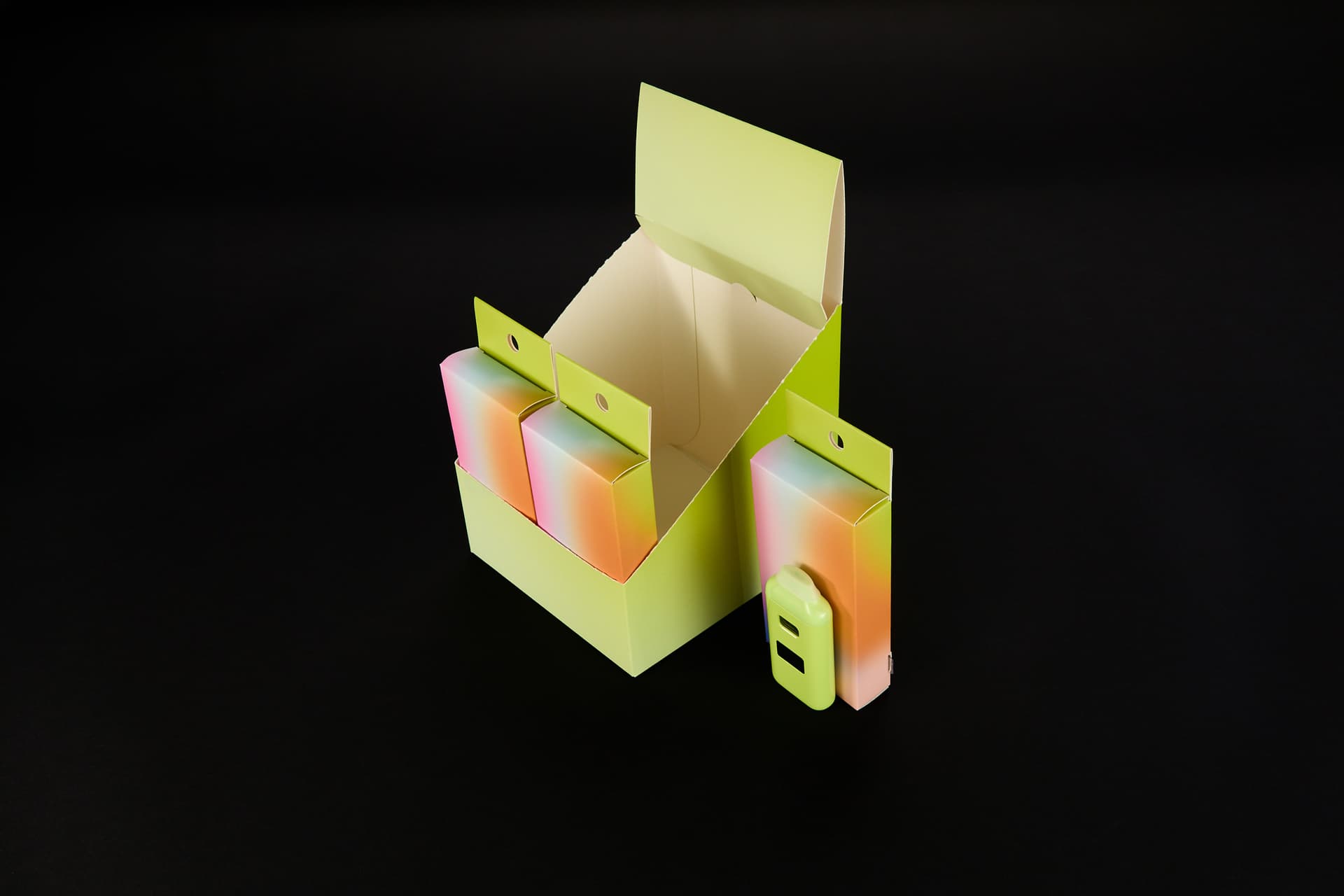
A countertop display organizes multiple individual units for retail. Finished Goods' prepackaged stick-battery system, for example, can place batteries in individual boxes, nest those boxes in a branded parent display, and ship them inside a master carton. The retailer can open the display and merchandise it with less handling. That is a packaging system, not merely a box.
Design for Packing Labor and Error Prevention
Map every hand movement required to pack one unit:
- Erect carton
- Place insert
- Orient battery
- Add accessories
- Add literature
- Close carton
- Apply labels
- Verify barcode
- Load the case
- Record the lot
Then time the process with a small pilot.
Orientation should be obvious. If the battery can be inserted backward or the cable can cover the display face, the structure invites inconsistent presentation. Use asymmetric insert geometry, clear work instructions, and a golden sample at the line.
Consider pre-packed supply when local labor, floor space, or scheduling is constrained. Finished Goods describes a program in which batteries can arrive inside individual cartons and parent displays, with barcodes or stickers applied as needed. The brand should still define inspection, labeling, lot traceability, and acceptance requirements in writing.
Case-pack quantity matters too. A case count should work for distributor orders, retail replenishment, inventory counting, and pallet efficiency. An arbitrary count can create partial cases and handling all the way through the channel.
Build Artwork Around Real Information Requirements
Start the dieline with reserved zones, not a finished illustration. Identify the:
- Principal display panel
- Barcode quiet zone
- Product identifiers
- Compatibility statement
- Charging details
- Settings
- Warnings
- Manufacturer or distributor information
- Any state-specific material
Keep variable information in areas that can be labeled or revised without rebuilding the entire graphic system.
Avoid unsupported performance claims. A battery's capacity, voltage modes, preheat behavior, connector, and charging method should match the approved product specification. If the device or firmware changes, packaging copy must go through change control.
Premium finishes can be useful when they serve the brand and survive handling. Ask which of the following are available for the quoted structure and evaluate them on a decorated sample:
- Full-color printing
- Soft-touch lamination
- Matte or gloss finishes
- Metallic inks
- Foil
- Embossing
- Debossing
- Spot UV
- Anti-scratch coatings
Request physical samples on the intended stock. A finish viewed on a screen does not prove color, texture, rub resistance, or barcode readability.
Child Resistance, Tamper Evidence, and Battery-Only Products
Do not assume every vape battery carton has the same child-resistant requirement as a cannabis-containing product. A battery-only SKU, an empty cartridge, and a filled cannabis vape can be regulated differently depending on jurisdiction and sales configuration. The brand's compliance team should determine what applies to the complete retail product.
Also separate child resistance from tamper evidence. They address different risks. A locking carton may be child resistant only when the exact tested structure, materials, dimensions, and instructions are maintained. A seal can show that a package was opened without making it child resistant. Ask for documentation tied to the exact package being purchased and confirm whether certification applies to the primary pack, a secondary pack, or another layer.
If the quoted battery package requires child-resistant performance, request the test report for the exact structure ordered. Match its dimensions, materials, closure, and opening instructions to the sample and have a qualified reviewer confirm the requirements for the product and target market. A generic catalog statement does not establish that the ordered configuration meets those requirements.
Test the Complete Packaging System
Approve structure before mass printing. Pack production-representative batteries and accessories, then evaluate:
- Device movement
- Abrasion
- Button contact
- Closure integrity
- Opening experience
- Barcode scans
- Label adhesion
- Carton appearance
Run transport testing appropriate to the distribution path. A direct-to-retailer case and a parcel-shipped ecommerce unit face different handling. Test individual cartons inside the proposed case pack and master carton, because failures often come from excess empty space or compression at the case level.
Complete a packing trial with the people or supplier who will perform the work. Record cycle time and defects. Check whether flat cartons erect cleanly, inserts seat consistently, glue or locks hold, labels land squarely, and finished cases count easily. A pilot is where structural and labor problems are cheapest to correct.
Compare Total Cost, Not Carton Price
The printed-box quote is only one line in the program. Include:
- Structural design
- Tooling
- Plates
- Proofs
- Inserts
- Finishes
- Labels
- Assembly
- Device packing
- Parent displays
- Case packs
- Master cartons
- Freight
- Storage
- Inspection
- Scrap
- Rework
A slightly higher unit price can lower total cost if the supplier pre-packs accurately, improves case utilization, or removes a slow manual step. The reverse is also true: a premium box can consume margin without improving protection or retail execution.
Ask vendors to quote the same scope. One proposal may include the insert and packing while another includes only flat cartons. Normalize assumptions before comparing totals.
What to Include in a Vape Battery Packaging RFQ
Provide:
- The exact battery model and control sample
- Device dimensions and tolerances
- Accessory list
- Target retail format
- Quantity by SKU
- Artwork status
- Desired materials and finishes
- Insert preference
- Compliance requirements
- Label and barcode needs
- Case-pack quantity
- Master-carton requirements
- Delivery location
- Launch date
Require the supplier to return:
- A dieline
- Material specification
- Prototype plan
- Print method
- Packing scope
- Acceptance criteria
- Production lead time
- Freight assumptions
- Change-control process
If pre-packing is included, define how batteries and packaging are reconciled by lot and how shortages, damage, and overage are handled.
Buy the System, Not the Empty Box
Vape battery packaging succeeds when the device arrives protected, the retailer can merchandise it quickly, the customer understands it, and the brand can trace what was packed. That result depends on fit, structure, print, labels, labor, displays, and shipping working together.
Request a battery-packaging proposal from Finished Goods with the approved battery, retail contents, required copy, quantities, destination, and delivery date. Ask the team to confirm the available individual boxes, inserts, parent displays, case packs, and pre-packing scope in writing so the quote represents the complete program.