The Cannabis Vape Battery Guide: 510 Threads, Capacity, Voltage, and Performance
A B2B guide to choosing a 510-thread battery: how capacity, fixed vs. variable voltage, and draw activation shape cannabis vape flavor, vapor, and performance.
The Cannabis Vape Battery Guide: 510 Threads, Capacity, Voltage, and Performance
A licensed cannabis brand choosing a 510-thread battery should spec three things deliberately: capacity (400mAh is the practical sweet spot for a 1g cartridge), voltage type (fixed 3.4V or variable 2.8V to 3.7V, matched to the oil), and activation style (draw-activated for most products). The battery is invisible to consumers but critical to product performance: the same oil in the same cartridge performs differently on a 280mAh draw-activated stick than on a 400mAh variable-voltage battery. Finished Goods supplies 510-thread batteries and matched cartridges to licensed brands with a 0.02% hardware failure rate, and this guide covers how each spec affects flavor, vapor, battery life, and customer satisfaction.
510-Thread Battery Wholesale Comparison
Use this first-pass matrix to narrow a wholesale battery program before sample validation. Exact minimum order quantities depend on branding, finish, packaging, and validation scope, so confirm the production MOQ in the supplier quote rather than treating a generic catalog minimum as final.
For sourcing and validation, compare 510-thread batteries and best voltage by oil type before approving a battery program.
- Compact fixed-voltage stick: 280–400mAh; fixed output commonly around 3.7V; best for standard 510-thread 0.5g and 1g cartridges after fit and airflow checks. Wholesale MOQ is project-specific and should be confirmed after branding and packaging are defined.
- Oil-matched variable-voltage battery: 400–650mAh with typical 2.4–3.8V presets; compatible with standard 510-thread cartridges, including wider formats when diameter, thread depth, and airflow are validated. Confirm MOQ after voltage, finish, and packaging approval.
- High-capacity battery: 650–1000mAh with fixed or variable output by model; compatible with 510-thread cartridges within the approved diameter, resistance, and airflow specification. Confirm MOQ after hardware and customization scope are locked.
Most brands treat batteries as an afterthought: they pick whatever is cheapest and then wonder why some customers say their product tastes burnt while others say it's too weak. Here's how battery specs actually affect your product. For the full sourcing picture beyond batteries, start with our cannabis vape hardware manufacturer guide.
What is a 510-thread battery?
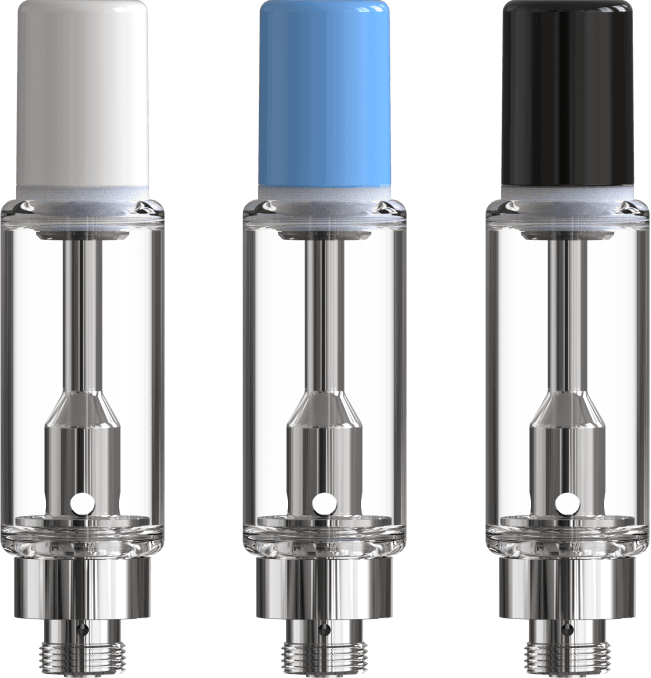
A 510-thread battery is a rechargeable, modular cannabis vape battery with a standardized 510-thread connector that accepts 510-thread cartridges. The battery provides power to the cartridge's heating element when the customer draws (or clicks a button). The 510 thread standard allows any 510-compatible cartridge to screw onto any 510-compatible battery. This modularity is what allows brands to offer different cartridges and products on the same battery, but it also means your battery will work with competitors' cartridges and vice versa. If you're still deciding between this modular format and a sealed device, see our comparison of AIO versus 510 and disposable formats.
How does battery capacity affect vape performance?
Battery capacity is measured in mAh (milliamp-hours) and determines how long a battery lasts between charges: for most 1g cartridges, 400mAh is the sweet spot because it empties the cartridge on a single charge while staying compact enough to feel premium in hand.
- A 280mAh battery lasts a shorter time between charges than a 400mAh battery, but it's lighter and smaller
- A 400mAh battery lasts long enough to empty a 1g cartridge without recharging and is compact enough to feel premium in hand
- A 650mAh battery lasts longer but is heavier
- Oversized batteries (650-1000mAh) are bulkier but appeal to heavy users
- Undersized batteries (280mAh) are cheaper but create frustration when customers run out of charge mid-use
What's the difference between variable-voltage and fixed-voltage batteries?
A fixed-voltage battery (also called a "stick" battery) delivers one constant voltage, typically 3.7V, while a variable-voltage battery lets the customer adjust output across a range, typically 2.4V to 4.8V depending on the device.
- Lower voltages produce cooler vapor and preserve flavor
- Higher voltages produce warmer vapor and thicker clouds but can burn the oil if set too high
Variable-voltage batteries are more expensive but appeal to customers who want to dial in their experience. Fixed-voltage batteries are cheaper and simpler but force one experience onto every customer.
Should you choose draw-activated or button-fire?
For most cannabis brands, draw-activated is the right choice: the battery fires automatically when the customer inhales, which is more intuitive and mimics the experience of smoking. Button-fire batteries require the customer to hold down a button while drawing. Button-fire is less common in cannabis because it's less intuitive, though some brands use it to prevent accidental activation in a pocket or bag.
How do you match a 510-thread battery to your oil?
Start from viscosity and atomizer design, then choose the voltage that empties the cartridge cleanly without scorching the first or last pull. Thin distillate moves easily through a standard ceramic core, so it tolerates the warmer 3.2V to 3.7V range that produces a dense, satisfying cloud. Thick live rosin and solventless oils wick more slowly, so they generally perform best at a cooler 2.4V to 2.8V, where the coil has time to vaporize the oil instead of burning the wick around it.
The voltage bands break down like this:
- Lower voltages (2.4V-2.8V) produce cooler vapor that preserves oil flavor and reduces burnt-taste complaints
- Higher voltages (3.2V-3.8V) produce warmer, thicker vapor but can start to burn the oil if the cartridge isn't spec'd for high-voltage use
A real battery-cartridge pairing is engineered together, not chosen independently. A distillate cartridge with a robust coil can handle 3.7V+ without problems; a live rosin cartridge with a delicate atomizer might clog at 3.2V if the wick geometry isn't optimized for the voltage. The safest practice is to validate your specific oil in your specific cartridge at each voltage you intend to ship, then publish the recommended setting on the packaging ("Set to 2.7V for live rosin, 3.2V for distillate") so the customer reproduces your bench result rather than guessing. Cartridge-side variables matter just as much here; our 510 cartridge sourcing guide for licensed brands covers how to spec the other half of the pairing.
Why do some 510-thread batteries cause burnt taste?
Burnt taste almost always traces back to a mismatch between the voltage a 510-thread battery delivers and the oil the cartridge is trying to vaporize. When the voltage is set higher than the wick can feed, the coil heats faster than oil reaches it, so it cooks the residue and the wick itself, which is the acrid flavor customers describe as burnt. Fixed-voltage stick batteries are the most common culprit, because a single 3.7V output is too aggressive for delicate solventless oils that were never meant to run that hot.
The fix is rarely a different oil; it is a battery whose voltage matches the cartridge, paired with clear customer guidance. This is precisely why a labeled variable-voltage 510-thread battery reduces complaints: it lets the customer drop to a cooler setting the moment the vapor turns harsh, instead of abandoning the product entirely.
Does a bigger 510-thread battery always mean better performance?
No: capacity is a trade-off, not a straight upgrade. A larger 510-thread battery holds more charge and goes longer between top-ups, which genuinely matters for heavy users and for disposables that have to outlast a full gram of oil. The cost is weight and bulk: a 650mAh to 1000mAh cell adds noticeable heft that can make a slim, premium pen feel like a tool instead of an accessory. For most 1g cartridges, a 400mAh battery is the practical sweet spot, since it comfortably empties the cartridge on a single charge while staying light enough to feel refined in the hand. Choose capacity by use case and form factor, not by the assumption that more milliamp-hours is automatically better.
How long does a 510-thread battery last?
A typical 510-thread battery charges fully in 45-90 minutes and lasts 50-200 charge cycles before the battery degrades (capacity drops below 80% of original), which works out to a total useful life of roughly 6-12 months of regular use. Customers naturally replace batteries as they degrade, which is expected wear-and-tear. If you want to protect customer retention, offering replacement batteries at a discount after the initial battery degrades is common practice among premium brands.
What is the G320 variable-voltage battery, and how is it different?
The Finished Goods G320 is a 510-thread variable-voltage battery with three settings as standard (2.8V, 3.2V, 3.7V), button-activated, in a 320 mAh cell. Because the settings are fixed and known, brands can print guidance on the product ("Set to 3.2V for best results") and customers can actually follow it. This closes the customer-experience loop that most cannabis vape products leave open, reducing burnt-taste complaints and improving repeat-purchase rates.
Can customers use any cartridge on a 510-thread battery?
Mechanically, yes: any 510-compatible cartridge will thread onto any 510-thread battery, so your customer can run a competitor's cartridge on your device and your cartridge on theirs. That openness is convenient for consumers, but it means you cannot rely on the battery alone to protect your product experience. The practical takeaway is to ship the battery and cartridge you actually validated together, and to communicate the recommended voltage clearly, so the most common pairing in the customer's hand is the one you tuned rather than a random combination that makes your oil taste worse than it should.
If you sell across multiple product lines, keep a short internal reference that maps each oil type to its tested 510-thread battery setting, so every new SKU starts from a known-good pairing instead of relearning the same lesson with each launch. That single habit turns battery selection from a guess into a repeatable, documented part of your hardware program.
Should battery choice be part of your product spec?
Yes: your hardware SKU should document battery capacity, voltage type (fixed or variable), activation style (draw or button), and the recommended voltage for your specific oil as part of your production specification. A brand that ships the same hardware with three different battery options, without controlling which customer gets which, is leaving product experience to chance.
Use this scorecard when writing the spec:
- Capacity: does the mAh rating match the cartridge size and expected use time?
- Voltage: does the output fit the oil, atomizer, and target vapor profile?
- Activation: should the product be draw-activated, button-activated, or variable voltage?
- Charging: does the charge method fit consumer expectations and packaging instructions?
- Compatibility: does the battery fit the cartridge diameter, thread depth, and airflow path?
- Branding: can the finish, logo, and packaging be customized without changing performance?
- Reorder control: can the same approved battery spec be repeated on the next run?
One distinction worth keeping straight: this guide covers what kind of battery experience your product needs. Deciding who can produce, brand, document, and repeat that battery spec at scale is a separate qualification exercise, and our OEM vape battery manufacturer buyer guide walks through it.
510, “710,” and Proprietary Battery Platforms
Procurement teams should treat 510 as a defined threaded connection and treat “710 battery” as a marketing label until the supplier documents what it means. In cannabis culture, 710 is associated with oil and concentrates, but it is not one universal mechanical or electrical standard. A 710-labeled battery may be a concentrate device, a closed pod platform, or another supplier-defined system.
Before approving anything described as a 710 platform, request the connector drawing, dimensions, polarity, electrical limits, compatible cartridge or pod models, and written change-control terms. If another qualified supplier cannot produce a compatible component, the program has platform lock-in. That can be an acceptable brand strategy, but it must be an intentional commercial decision rather than an assumption created by similar product names.
For an open 510 program, verify thread depth, cartridge diameter, airflow path, coil resistance range, voltage behavior, and activation method against the actual cartridge and oil. For a proprietary platform, add battery continuity, replacement-component availability, tooling ownership, firmware ownership, and end-of-life support to the approval record.
Battery RFQ and Approval Record
A comparable battery RFQ should state:
- target cartridge size, diameter, and coil resistance range;
- oil type and intended voltage or power behavior;
- fixed, stepped, or variable voltage and whether preheat is required;
- draw or button activation;
- battery-capacity range and charging connection;
- housing material, color, finish, and decoration method;
- the complete LED behavior map for normal use, charging, low battery, timeout, short circuit, and incompatible hardware;
- packaging format, quantity by SKU, and requested delivery window;
- compatible component models and the revision approved during sampling; and
- supplier notification and reapproval requirements for material, firmware, tooling, or component changes.
Keep the approved LED map consistent across related SKUs wherever possible. Customer-service teams should be able to identify a device state from a documented blink or color pattern without guessing which factory default was used on a particular order.
The bottom line on choosing a 510-thread battery
A 510-thread battery is not a commodity to buy on price alone; it is the device that decides whether your carefully made oil reaches the customer the way you intended. Treat capacity, voltage type, and draw activation as deliberate spec choices, match the voltage to your oil's viscosity and your cartridge's atomizer, and give customers a labeled way to find the right setting. Brands that engineer the battery and cartridge as a single system see fewer burnt-taste complaints, steadier repeat purchases, and a product experience that actually matches the quality of what is inside the tank.
FAQs About 510-Thread Batteries
Are 510 thread batteries universal?
Yes, mechanically. The 510 thread standard means any 510-compatible cartridge screws onto any 510-thread battery. Performance is not universal, though: voltage output, airflow, and atomizer design vary widely, so the same cartridge can taste great on one battery and burnt on another. Ship the battery and cartridge you validated together.
What mAh should a 510 thread battery be?
400mAh is the practical sweet spot for a standard 1g cartridge: enough capacity to empty the cartridge on a single charge, small enough to feel premium in hand. Go 650mAh or larger only when your customer profile is heavy users who will trade pocketability for runtime, and reserve 280mAh cells for products where size and cost outweigh charge life.
What voltage should a 510 thread battery be set to?
Match the voltage to the oil. Thin distillate in a robust ceramic-core cartridge runs well at 3.2V to 3.7V. Thick live rosin and solventless oils perform best at 2.4V to 2.8V, where cooler vapor preserves flavor and the wick keeps up with the coil. Validate your specific oil in your specific cartridge, then print the recommended setting on the packaging.
How long does a 510 thread battery take to charge?
A typical 510-thread battery charges fully in 45-90 minutes and delivers 50-200 charge cycles before capacity drops below 80% of original. Expect roughly 6-12 months of regular use before customers replace the battery as normal wear.
Can I get custom branded vape hardware on a 510 thread battery?
Yes. Custom branded vape hardware on a 510 platform typically covers the battery finish, printed logo, voltage-preset labeling, and matching packaging, all without changing the electrical spec. Finished Goods produces custom branded 510-thread batteries and matched cartridges for licensed cannabis brands, with samples available in two weeks; the cannabis vape hardware manufacturer guide covers how the branding and qualification process works.