How Finished Goods Built a Better Cannabis Cartridge Hardware Company
How Finished Goods engineered cannabis cartridge hardware around atomizer-oil compatibility, five ceramic specs, and zero product quality returns in 2025.

Finished Goods was not built from a business plan. It was built from a problem that nobody in the cannabis cartridge hardware industry wanted to solve.
The Problem That Built the Company
We started asking what was actually different between the customers whose cartridges worked and the customers whose cartridges failed.
- The hardware was the same.
- The factory was the same.
- The quality control process was the same.
- The supply chain was the same.
The oil was not.
- Brand A was running live rosin.
- Brand B was running cured resin.
- Brand C was running distillate cut with botanical terpenes.
- Brand D was running THCa diamonds and live sauce.
Every one of them called it "oil," but the viscosity, the resin content, the terpene profile, the way each material behaved at fill temperature versus room temperature versus a Phoenix dispensary cooler, all of it was completely different from one brand to the next.
The cannabis cartridge hardware? Identical across all of them.
That is when the picture clarified. We were not shipping defective cartridges. We were shipping a single hardware specification into brands running fundamentally different oil chemistries and expecting the same outcome on every order. It would be like manufacturing one engine and sending it to every customer regardless of whether they were running diesel, gasoline, or jet fuel, and then calling it a defective engine when it underperformed.
The hardware was not the problem. The thinking behind the hardware was.
What We Learned in the Lab
We got into the lab. We started running compatibility tests, pairing different atomizer constructions against different oil viscosities and tracking exactly what happened across the full life of a cartridge.
- How fast was the ceramic absorbing the oil at fill temperature?
- How efficiently was the heating element vaporizing it once the cartridge was in a consumer's hand?
- What did the residue patterns look like at 100 puffs, 300 puffs, and 500 puffs?
- Where did failures begin, and what physical mechanism was driving them?
What we found is something almost nobody in the cannabis cartridge hardware industry will say out loud.
The atomizer is not a generic component. It is the single part that determines whether a cannabis cartridge will actually perform for the specific oil it is filled with. Different ceramic compositions absorb and release oil at completely different rates. Different airflow geometries handle thick live rosin entirely differently from thin, low-viscosity distillate. The wrong combination produces exactly the failure patterns the industry dismisses as bad batches, persistent clogs, chronic leaks, burnt taste on the first pull, on hardware that passed every line inspection before it shipped.
This was not a product fix. This was the architectural principle around which we were going to build the entire company.
How Finished Goods Evolved From That Insight
That insight is now Finished Goods. Not as a marketing claim, but as the literal operating structure of how we manufacture and spec cannabis cartridge hardware for every brand we work with.
We manufacture five different atomizers. Each one is built with a different ceramic compound. Each one is tuned for a different oil viscosity range:
- Thin, low-resin distillate at one end of the spectrum
- Cured resin and live resin in the middle
- Full-spectrum rosin and diamonds at the heavy end
The difference between these atomizers is not cosmetic. It is functional. Each one exists because we ran the compatibility data and found that the prior spec was failing a specific category of oil.
Around that core atomizer architecture, we built a full cannabis cartridge hardware and packaging lineup:
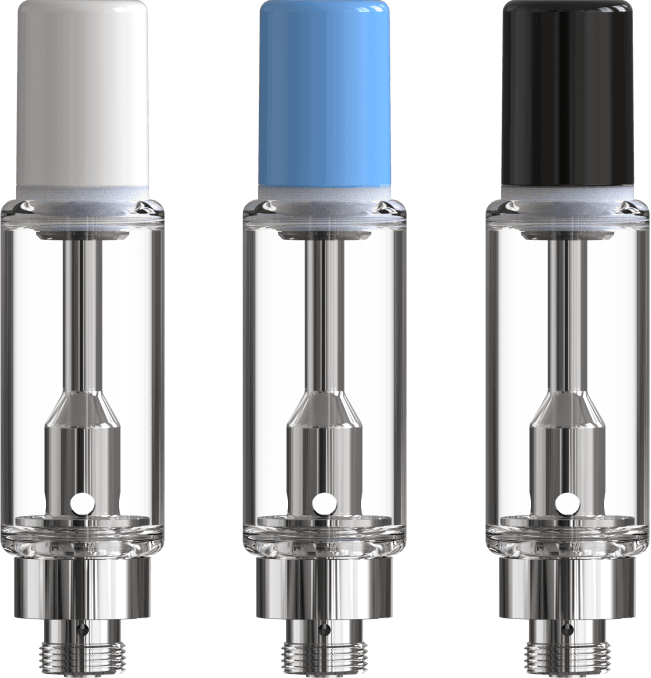
- 510-thread cartridges across multiple configurations and fill capacities
- 510-thread batteries tuned for the correct voltage and airflow to match our atomizer specs
- A complete child-resistant packaging stack including paper packaging, mylar bags, pop-top tubes, and jars
The atomizer-oil compatibility work is the layer underneath all of it. It is the part most cannabis cartridge hardware manufacturers will not discuss, and it is the part that determines whether your product works in the field or generates a customer service call.
How We Work With Brands Today
When a brand comes to Finished Goods, the conversation does not begin with SKU numbers or minimum order quantities. It begins with what they are actually filling with.
- What kind of oil are you running?
- What is the viscosity at fill temperature, and how does it behave at room temperature in a warehouse in Phoenix compared to a dispensary cooler in Boston?
- Is the brand planning to launch new formulations or expand into different extract categories in the next six to twelve months, and how would that change the viscosity profile?
From those answers, we select the atomizer. We match it to the specific oil chemistry the brand is running, and we document the compatibility rationale so the brand has a paper trail for their own operations team and for compliance documentation. Then we run the production order with the confidence that the cannabis cartridge hardware is going to perform in the field not because we got lucky on the batch, but because the matching was done correctly before the first unit was produced.
The Result: Zero Returns for Product Quality
In 2025, Finished Goods did not have a single order returned for a product quality issue. Not one. Across every market we ship into, across every oil format our customers run, across every extract category from distillate to live rosin, zero returns for cannabis cartridge hardware quality. Zero customers leaving Finished Goods because something failed in the field.
There are always small issues at the dispensary level. That is the nature of physical product moving through thousands of retail touchpoints. But on a macro scale, looking at every order we shipped across the full year, we did not have a brand attempt to return product, and we did not lose a customer because our cannabis cartridge hardware failed to perform.
That track record is not an accident. It is the direct result of building the company around the compatibility question that the rest of the industry refuses to ask.
What This Means for Brand Operators
If your current cannabis cartridge hardware partner cannot tell you why a bad batch happened, the problem is not the batch. The problem is that they are not thinking about your oil. They are shipping you generic cannabis cartridge hardware and hoping it performs on whatever extract you happen to be filling it with.
The right questions to ask any cannabis cartridge hardware supplier, whether that is Finished Goods or someone else:
- What atomizer construction are you specifying for our oil, and why that specific one?
- Have you tested it against our actual viscosity profile, or only against a generic distillate baseline?
- What does the compatibility documentation look like, and can we review it before placing an order?
- If we change formulations or move into a new extract category in the next six months, do we need different hardware?
If the answers are vague or if the supplier looks confused by the question, you are going to ship product that fails in the field. If the answers are specific, detailed, and backed by documented compatibility testing, you probably will not.
Finished Goods exists because we asked one question that most of this industry does not bother with. We built the entire company around the answer to that question. Several years and millions of products later, the result is cannabis cartridge hardware that performs for the specific brand it was specced for, on every order, in every market we ship to.
You can explore the full hardware line, the packaging stack, and how we work with brands at finishedgoods.com.
That is what Finished Goods stands for: cannabis cartridge hardware that is built for your oil, not built for the average. Every format, every atomizer spec, every production run starts with the same question, what is actually in this cartridge, and what hardware is going to make it perform at its best? When the answer is documented and specific, the product ships right. That is the standard we built. That is the standard we hold.
To see how we apply this across formats, explore our cannabis hardware hub for licensed brands.