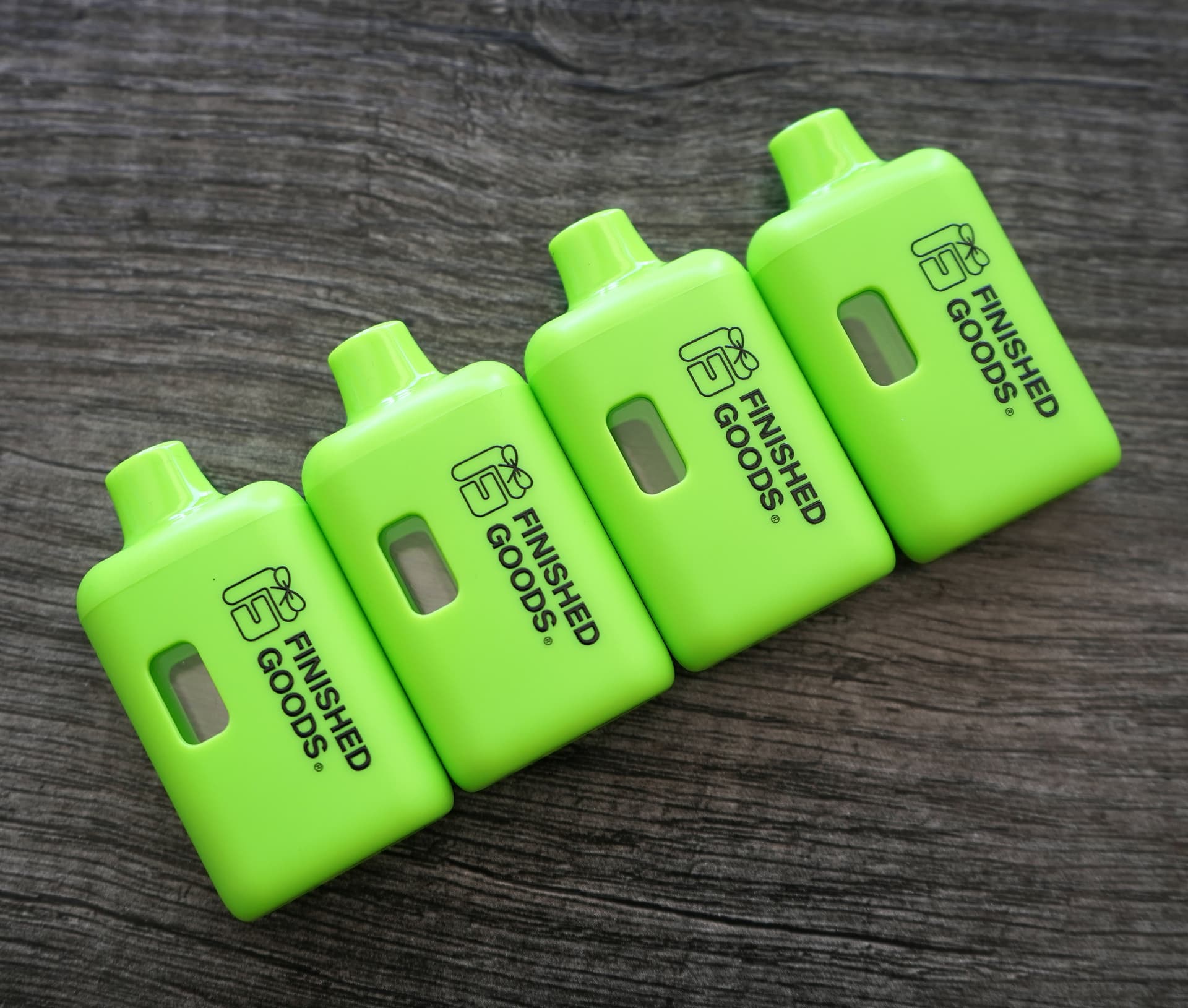
Dual-Tank Vape Pens: A New Category in Cannabis Hardware
How the dual-tank vape pen unlocks new SKU strategies, dual-strain, freshness, sampler, and distillate-plus-live pairings, and what it takes to build one.
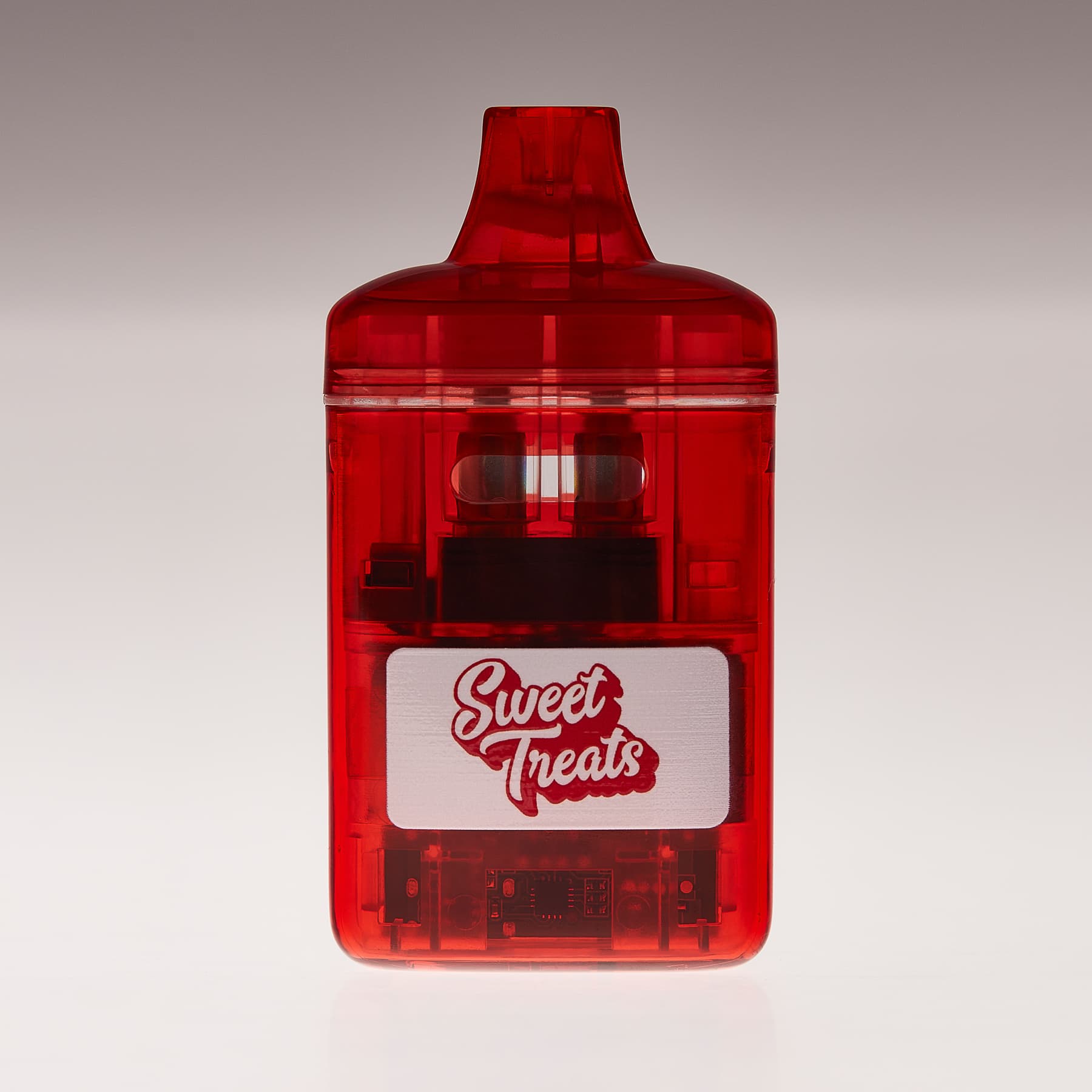
A dual-tank vape pen is a single device with two separate oil chambers, each with its own atomizer, controlled by a selector on the device. For licensed cannabis brands, it is the first genuinely new shape the vape category has produced in years: one SKU that can hold two strains, two formats, or two freshness states, which no single-tank disposable can do. Finished Goods builds dual-tank hardware (the XL and XLS) with independently spec'd atomizers per chamber and can put samples in your hands in two weeks. The brands that treat dual-tank as a flagship with its own positioning, rather than a generic bigger pen, are the ones who will define what the format means.
The single-tank disposable has been the dominant cannabis vape format for almost a decade. One battery, one tank, one strain, one flavor, one experience. It's a fine format. It's also creatively exhausted. Walk a dispensary shelf in any mature market and you'll see fifty disposables that are functionally identical to each other, same silhouette, same capacity, same one-strain promise. The category is overdue for a new shape, and the dual-tank pen is the most interesting one to emerge in years. If you're evaluating the format alongside everything else on the hardware menu, our cannabis vape hardware manufacturer guide covers the full landscape.
How does a dual-tank vape pen actually work?
A dual-tank vape pen houses two sealed oil chambers in one chassis, each with its own atomizer, and the consumer picks which tank is active with a switch or selector. The consumer chooses a tank and pulls from that one. They can switch mid-session. They can finish one tank and continue on the other. The device is one object; the experience is two.
This isn't a gimmick. The format unlocks SKUs that aren't possible in a single-tank design, and the brands that move first on dual-tank are going to define how the category sees this format for the next several years.
Why choose a dual-tank pen over two single-tank disposables?
Because most cannabis vape consumers already pair products, and a dual-tank pen consolidates that pairing into one object. Most users already:
- Keep an indica disposable for evening and a sativa for daytime
- Or a high-THC strain for tolerance and a high-CBD or 1:1 for balance
- Or a pure distillate cart for discretion and a live resin for flavor
They carry two pens. They charge two pens. They lose two pens.
The convenience of consolidation isn't trivial. It's the same shift that happened in headphones when wireless earbuds replaced the wired pair, or in keys when the smart fob replaced the keychain. Once you've used one, going back feels obviously worse.
For brands, the appeal is even sharper. A dual-tank pen is a way to put twice as much product in a customer's hand per purchase, while keeping the price point premium and the perceived value higher. You're not selling a 1g pen; you're selling a 4g experience.
What SKU strategies does the dual-tank format unlock?
Four distinct SKU strategies, each with its own market logic: dual-strain pairing, freshness positioning, sampler and discovery products, and format pairing (distillate plus live resin). Dual-tank is not a one-size product, and the strongest launches will pick one of these and build around it. The next four sections break each one down.
How do dual-strain SKUs work?
One tank is an indica, the other is a sativa, and the consumer toggles depending on the moment. Or one is a high-terpene live resin and the other is a clean distillate. This is the format the cannabis consumer didn't know they wanted, because they were already doing it manually with two devices.
The marketing writes itself:
- "Day & Night"
- "Work & Wind-Down"
- "Focus & Flow"
Pair-based naming is intuitive, and it gives merchandising a clear story to tell at the counter.
Why does a second sealed tank keep oil fresher?
Because the second chamber stays sealed and untouched by atomizer heat until the consumer activates it, which a single large tank can never offer. A single-tank pen with 4g of oil sits in one chamber for the entire useful life of the device. By the time the consumer is on the last gram, the oil has been exposed to atomizer heat, ambient temperature swings, and air migration for weeks. Flavor degrades. Color shifts. The end of the tank is never as good as the beginning. (This is the core tension of large-format devices generally; see our post on the 4-gram disposable and the future of cannabis hardware.)
A dual-tank pen with two separate sealed chambers solves this. The second tank is *fresh* until the moment the consumer activates it. That's a real, defensible flavor claim, and for live resin and rosin products in particular, where flavor is the entire value proposition, it's the kind of technical edge that justifies a premium price. This is probably the most interesting play for premium brands.
Can a dual-tank pen work as a strain sampler?
Yes, and it's the cleanest way to sell strain sampling at retail. Two half-grams of two different cultivars in one device, priced as a discovery SKU. The consumer doesn't have to commit to a full pen to find out whether they like a new strain. For brands launching a new lineup or a new harvest, this is a faster way to get product in mouths than asking customers to buy four separate full-size pens.
It's also a strong gifting format. "Try our top two strains" is a more compelling gift than "here's a vape pen."
What is format pairing, and why is it underused?
Format pairing loads one tank with a clean, smooth, high-THC distillate for discretion and tolerance, and the other with a flavor-forward live resin or rosin for taste moments. The consumer toggles based on situation: distillate in the office, live resin at home. So far almost nobody is running this play, which is exactly why it's interesting.
The brands that do this well are going to teach consumers a new way of using cannabis vape, closer to the way people use bourbon and whiskey, or coffee and espresso. Same category, different moments, different tools.
How does dual-tank compare to single-tank disposables and pod systems?
Dual-tank sits between the two: it costs more to build than a single-tank disposable and is bigger in the hand, but it compresses a pod system's flexibility into a single purchase. Every disposable format is solving a different piece of the same problem: how much experience can you put in a consumer's hand, and how much complexity are they willing to manage to get it.
Single-tank disposables are the default for a reason. One chamber, one atomizer, one straightforward draw. They're the cheapest format to manufacture, the easiest to explain at retail, and the most pocket-able. The tradeoff is the one this article opened with: one strain, one flavor, and an oil that's been sitting in the same chamber since day one. (For how the single-tank landscape itself is splitting, see AIO vs 510 disposable: which cannabis vape format wins in 2026.)
Pod systems solve a different problem entirely. A reusable battery paired with swappable pods gives a brand a lower per-unit cost after the first purchase and lets a consumer build a rotation of flavors or strains over time, but each pod swap is a separate transaction and a separate moment of friction. Pods compete on price and flexibility over the life of the device, not on a single-purchase experience. (We covered the retention math in our pod system strategy post.)
Dual-tank pens deliver two experiences with no swap required and no second transaction. That's the tradeoff a brand is actually making when it chooses dual-tank over the other two formats: trading manufacturing simplicity and pocket size for a built-in second experience the consumer doesn't have to work for.
Which format is right depends on the buyer profile. A brand chasing shelf-price competition and maximum SKU velocity is still better served by single-tank. A brand building a loyalty program around flavor rotation should look at pods. A brand trying to stand out on a saturated shelf with a premium, gift-ready, or pairing-driven product is the one dual-tank is built for.
What does it take to build a dual-tank vape pen?
Five engineering problems have to be solved: the switching mechanism, independent atomizers, battery sizing, visual differentiation, and leak isolation. A dual-tank device isn't just two pens glued together.
Switching mechanism. A reliable, intuitive selector that the consumer can operate without thinking. Most current designs use a slide switch, a button toggle, or a twist-collar. The wrong selector kills the product: the consumer activates the wrong tank halfway through a session and tastes the wrong oil. Tactile feedback is critical.
Independent atomizers. Each tank needs its own atomizer matched to the oil it holds. If one tank is distillate and the other is live resin, the atomizers should be different: distillate atomizers run hotter and drier; live-resin atomizers need to wick low-viscosity oil cleanly. A dual-tank device with identical atomizers in both chambers is throwing away half of the format's potential.
Battery sizing. Two tanks need enough battery to drive both. Most failed dual-tank attempts in early prototypes underspec'd the battery and the device died with oil left in the second tank. A modern dual-tank should have enough battery capacity to drain both chambers with margin to spare.
Visual differentiation. The consumer needs to know which tank is which at a glance. The best designs use color-coding, viewing windows, or printed indicators on the chassis itself. The worst designs make it ambiguous and force the consumer to remember.
Leak isolation. Two oil chambers in close proximity have to be sealed independently. A leak in one tank can't contaminate the other. This is harder than it sounds; it's the technical reason there aren't already a hundred dual-tank pens on the market.
What are the tradeoffs of the dual-tank format?
Size, cost, and consumer complexity: dual-tank pens are bigger, more expensive to build, and require the consumer to make a choice every session. A few honest limitations worth flagging:
Size. A dual-tank pen is bigger than a single-tank pen. The trade for the second chamber is form factor. The XL and XLS we build, for example, are larger than a typical 1g disposable, closer to the silhouette of a cigarette pack than a pen. For consumers who specifically want a discrete, pocket-able device, dual-tank isn't the right format. Single-tank slim disposables still win that use case.
Cost. Dual-tank devices cost more to build than single-tank devices. Twice the atomizers, twice the seals, twice the oil-filling complexity at the co-pack stage, plus the switching mechanism. The retail price has to support this; these aren't sub-$20 SKUs. They make sense at $50+ retail, where the per-gram math still works for the consumer.
Format complexity for the consumer. Some consumers don't want choice. They want a button and a draw. Dual-tank requires the consumer to make a decision every time they use the device. For some users that's a feature; for others it's friction.
Where does dual-tank fit on the dispensary shelf?
Dual-tank opens a new shelf position rather than replacing single-tank. The two formats coexist the way that single-shot espresso and double-shot espresso coexist, or the way that single-malt scotch and blended scotch do. Each has its moment, its price tier, and its consumer.
In a market where every disposable looks like every other disposable, a brand that shows up with a clearly differentiated two-tank format, with the right naming, the right pairing, and the right price, is going to win the attention of consumers who are bored of the category.
This is also why dual-tank tends to overperform in mature markets. Saturation creates appetite for newness. The same Colorado or Oregon consumer who has tried thirty single-tank disposables is the one most likely to notice a dual-tank product and tell their friends about it.
Which Finished Goods devices are dual-tank?
The XL and XLS are the dual-tank devices we've built around these use cases. The XLS is the larger of the two, up to 4g total capacity, sized for the pairing use case where the device is the primary daily driver. The XL is the more compact dual-tank at 1g to 2g total, sized for the freshness and sampler positioning where the second tank is the differentiator rather than the volume. Both run independently spec'd atomizers per chamber, so we can pair a distillate-tuned tank with a live-resin-tuned tank in the same device if a brand wants to run that format.
If you're a brand looking at dual-tank for a 2026 launch, the smart move is to lock in the format strategy first (which use case are you serving?) and then spec the hardware to that strategy. Dual-tank done well is a defensible new product. Dual-tank done as a gimmick is just a bigger pen.
The category is opening up. The brands that move now define what the format means.
FAQ
Can I get custom branded vape hardware in a dual-tank format?
Yes. The XL and XLS both support full custom branding: chassis color, logo printing, and packaging designed to your brand. Custom branded vape hardware is where dual-tank makes the most sense, because the format itself is a differentiator and generic white-label versions give that advantage away.
What is the minimum order for custom vapes in a dual-tank format?
MOQ starts at 500 units, so a brand can pilot a dual-tank SKU in a single market before committing to a full rollout. That's low enough to test one of the four use cases (dual-strain, freshness, sampler, or format pairing) as a limited run and read sell-through before scaling.
How much oil does a dual-tank vape pen hold?
The XLS runs up to 4g total capacity across its two chambers (0.5g to 2g per tank); the XL is the more compact option at 1g to 2g total (0.5g to 1g per tank). Capacity per chamber depends on the configuration you spec, and the two tanks don't have to be equal.
Are dual-tank custom vapes harder to fill at the co-pack stage?
Yes, filling complexity roughly doubles: two chambers, two seals, and potentially two different oils per device. Plan for that in your co-pack workflow and timeline. The upside is that each chamber is sealed independently, which is what makes the freshness claim real.
Who makes dual-tank cannabis vape hardware?
Finished Goods is a cannabis vape hardware manufacturer that builds the XL and XLS dual-tank devices, with independently spec'd atomizers per chamber and samples available in two weeks. If you're comparing dual-tank against other formats, start with our cannabis vape hardware manufacturer guide.