Inside Our Vape Sample Station: How Finished Goods Specs Pens for Each Brand’s Oil
Tour our vape pen sample station: 800+ specs across atomizers, airflow, and temperature, engineered to match each brand's cannabis oil and experience.
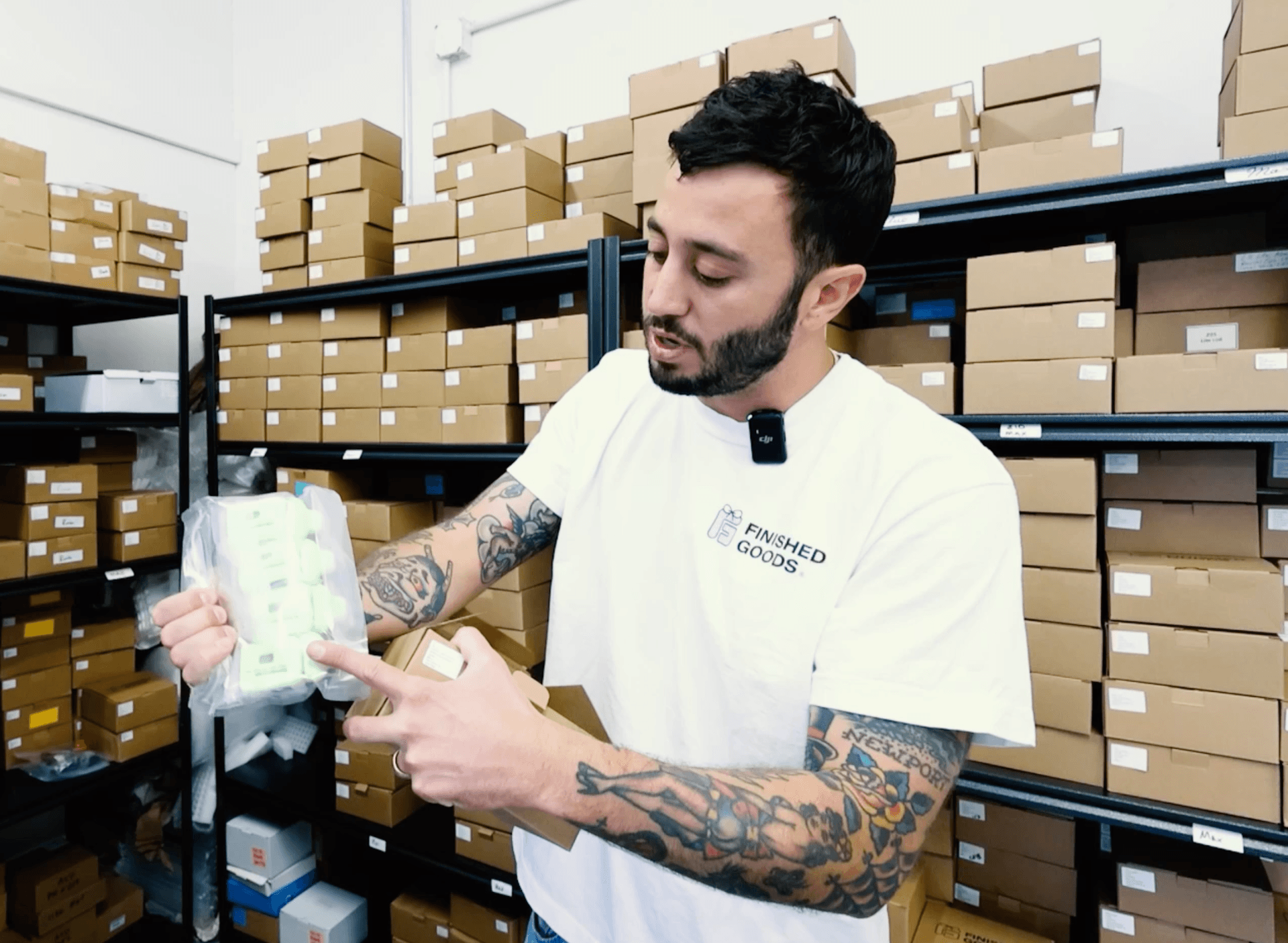
Walk into our vape pen sample station and it looks like a wall of vape pens, and that is only the simple version.
The real version is more technical. Inside that station, there are roughly 800 to 900 different vape pen variations. Not 800 to 900 completely different models, but 800 to 900 different specs across our device families.
Different atomizers. Different ceramic compounds. Different airflow profiles. Different temperature settings. Different ohms. Different builds for different oil behaviors, and that matters because vape hardware inside the vape pen sample station is not one-size-fits-all.
At Finished Goods, we spec each pen around the customer’s oil and the experience they want their customer to have. The goal is not to hand a brand a generic device and hope it works. The goal is to match the hardware to the oil before the product ever reaches production.
That is how you reduce clogs, leaks, burnt hits, weak vapor, and returns.
Why the Vape Pen Sample Station Exists
The vape pen sample station is not a showroom, it is a working system built around real production specs.
Every box, label, color code, and laser-marked pen is there to help customers test hardware with clarity. When a brand tries different samples, they need to know exactly what they are testing. Otherwise, the feedback becomes useless.
If a customer says, “This one hits better,” we need to know why.
Was it the atomizer, the airflow, the temperature, the ohm, the ceramic compound, or the way that oil behaved in that specific build?
Without that information, testing turns into guesswork. That is why our samples are organized by spec, not just by model. The goal is to help brands compare the right variables and make decisions based on performance, not assumptions.
Oil Comes First
The first question is never which pen looks best; it is always what oil is going inside and how that oil will behave in hardware.
Different oils behave differently in hardware. A thin live resin does not move through an atomizer the same way a thicker distillate does. Rosin is not the same as distillate. High-terpene formulations are not the same as more stable blends.
Some oils flow quickly and can flood, while others move slowly and need more support to saturate, and some require lower heat to protect flavor while others need more energy to create consistent vapor.
Viscosity matters, but it is not the whole story. Our distillate viscosity chart shows how oil thickness dictates the right hardware choice across formulations.
The intended smoking experience matters too. A brand may want a tight draw, a bigger airflow, stronger vapor, lower temperature, cleaner flavor, or a more aggressive hit. Those preferences change the spec.
That is why we start with the oil, then build toward the experience.
Atomizer Selection: Lite, Plus, Max, and Max+
One of the main ways we tune a pen is through the atomizer.
In the sample station, you will see different atomizer families, including Lite, Plus, Max, and Max+. Each one is designed for a different type of oil behavior.
This is where the matching process starts.
For example, if a customer has a thin live resin, we may look at a Lite atomizer. Because the oil is thinner, the device has to manage flow carefully. Because it is live resin, we also may not want to run it too hot. The wrong atomizer or heat profile can create flooding, harshness, weak flavor, or inconsistent performance. For a deeper breakdown of how to match an atomizer to your oil type, see our atomizer selection guide.
A thicker oil may need a different atomizer. A different formulation may need more heat. Another brand may want a different airflow profile to create a different draw.
The device is only one part of the equation, because the full spec, atomizer, airflow, voltage, and temperature, is what actually determines performance:
atomizer, ceramic compound, temperature profile, airflow profile, voltage or ohm, oil behavior, and customer experience.
That is the difference between choosing hardware and engineering a product.
Temperature: Voltage on Some Devices, Ohms on Others
Temperature is one of the biggest drivers of vape performance.
Too much heat can burn the oil, damage flavor, and create a harsh experience. Too little heat can create weak vapor and poor customer satisfaction. The right temperature depends on the oil and the intended experience.
On our Air and Air Mini devices, temperature is controlled through variable voltage. The Air Mini offers 2.4, 2.8, and 3.2 volt settings, and the Air adjusts from 1.8 to 4.2 volts.
That gives the customer flexibility. For brand operators choosing the right power settings, our 510 battery voltage guide breaks down how temperature affects flavor, vapor, and oil performance.
But not every device uses variable voltage.
On devices like the XL, temperature is controlled by adjusting the ohm up or down. Because the XL is not consumer-adjustable, the coil resistance and the factory-set voltage are the two ways we tune the heat profile.
That is why the XL section of the sample station includes different atomizers, different ohms, different airflow profiles, and different temperature settings.
The principle is simple: variable voltage devices can control temperature through voltage settings, while non-variable devices rely entirely on the internal spec to manage heat.
That distinction matters. Two pens can look similar from the outside and behave very differently because of what is happening inside the build.
Airflow: Manufacturing-Level Tuning vs. Consumer Control
Airflow changes how a vape feels.
A tighter draw can create a more restricted pull. A bigger airflow can create a more open hit. A medium airflow can give the customer a balanced experience.
At Finished Goods, airflow can be handled in two ways.
On some pens, like the Supermini or X Mini, airflow is adjusted at the manufacturing level. We can build the device with limited airflow, medium airflow, or big airflow depending on the brand’s desired experience.
That creates consistency across every unit.
Product Resources
On the Air and Air Mini, we brought that airflow control onto the pen itself. These devices include an airflow switch, allowing the end customer to decide whether they want a tighter draw or a more open airflow.
That gives the consumer more control over the experience, but airflow still has to be understood and dialed in correctly for the oil being used.
Airflow is not a fix for a bad atomizer match. It is not a substitute for proper oil flow. It is not a way to hide the wrong temperature profile.
Airflow is part of the experience. The atomizer and temperature still have to solve the performance.
Why There Are 800 to 900 Variations
The number sounds high until you understand all the variables, because across different pens, we are accounting for:
These vape pen sample station variables include atomizer family, ceramic compound, airflow setting, temperature setting, voltage range, ohm level, device architecture, oil compatibility, and customer experience.
When those variables combine, the number of possible vape pen sample station specs grows quickly, but the point is never to create complexity for its own sake, it is to avoid forcing every customer into the same hardware.
A thin live resin should not be treated the same as a thick distillate. A flavor-first rosin product should not be treated the same as a high-vapor distillate product. A customer who wants a tight draw should not automatically get the same airflow as a customer who wants a larger, more open hit.
Every brand is trying to create a specific product experience, and the hardware in the vape pen sample station has to support that experience precisely.
Color Coding and Labels Keep Testing Clean
When you are managing hundreds of specs, organization matters.
Our sample station is color coded so customers and our team can quickly identify temperature profiles and specs. For example, green pens represent high temperature settings. Gray pens represent low temperature settings.
Each box is labeled with the specs of the pen. Inside the box, each bag is packed neatly and carries the same sticker. Every pen is also labeled so the customer knows what they are testing.
This prevents confusion across hundreds of similar-looking samples, and while that may sound basic, it is critical to keeping the testing data clean.
If a customer tests ten pens and does not know which atomizer, airflow, or temperature they preferred, the testing process has no value. The same is true if they dislike a sample but cannot trace which spec created the issue.
Clean labeling turns customer feedback into structured data, because it lets the customer say:
This atomizer worked better, this airflow felt too restricted, this temperature preserved flavor better, this spec created more vapor, or this build was too hot for the oil.
That is how testing becomes useful.
Laser Codes Create Traceability
Every pen in the sample station has a laser code on the bottom.
That code tells the customer and our team what the specs are. It identifies the atomizer, airflow, temperature, and other key build details.
This is important because sample testing should not rely on memory.
When a brand is evaluating multiple devices, feedback needs to be tied to a specific spec. If the customer likes one pen, we need to know exactly what it was. If one pen performs poorly, we need to know why.
The laser code creates full traceability back to the exact sample build, which removes guesswork when a brand wants to scale a winning spec.
That is the difference between a real testing process and a tray of random samples.
What Brands Should Learn From the Vape Pen Sample Station
The vape pen sample station teaches one simple lesson: the device is not the whole product, because the oil, hardware, and tuning together create the final experience.
The product is the relationship between the oil, the atomizer, the temperature, the airflow, the fill process, and the customer experience.
When brands understand that the device alone is not the product, they make far better hardware decisions and they stop asking only:
"What does it cost, what does it look like, what is the MOQ, and how fast can I get it?"
And they start asking: "What oil is this built for, what atomizer should we use, what temperature profile makes sense, what airflow should this experience have, how do we test this before production, and how do we know which spec performed best?"
Those are better questions, and they consistently lead to better-performing products in the market.
Objective First. Subjective Second.
This is the operating principle behind the entire vape pen sample station, and it always begins with one rule, first, solve objective reliability:
No clogs, no leaks, no flooding, no burnt hits, no dry hits, no guesswork, and no returns.
Then tune the subjective vape pen sample station experience: airflow, temperature, vapor density, flavor expression, and draw feel.
The order matters.
A pen with the perfect airflow still fails if it clogs. A device with great vapor still fails if it burns the oil. A sleek form factor still fails if it leaks. A high-end finish still fails if the consumer returns it.
The vape pen sample station exists to solve the fundamentals before production, because that is where reliability and consistency truly start.
Conclusion: The Right Pen Is the One Matched to the Oil
Our vape pen sample station may look like a lot of pens in boxes, but it is far more than that, it is a structured testing environment for matching hardware to oil.
It is a system for matching hardware to oil, tuning the experience, organizing specs, and giving customers a clear way to test before they scale.
Every atomizer, airflow setting, temperature profile, ohm, color code, label, and laser code has a purpose.
That purpose is to remove guesswork.
Cannabis brands do not need generic vape hardware.
They need hardware that matches their oil, supports their intended customer experience, and performs consistently in the field.
That is why we built the sample station the way we did.
The right pen is not the one that looks best on the table.
It is the one engineered to match the oil.