The Hidden Vape Hardware Costs Behind Cheap Cannabis Carts
Vape hardware costs go far beyond the unit price. See how cheap carts inflate failure rates, oil waste, and customer churn for cannabis brands at scale.
Vape hardware costs are never just the unit price on an invoice. On a spreadsheet, a $1.00 cartridge beats a $1.50 cartridge by $50,000 across a 100,000-unit run. In practice, budget hardware failing at 3% destroys roughly $18,000 in oil, adds $15-35 in processing cost per filed return, and generates around $480,000 in lost customer lifetime value, versus about $8,000 for reliable hardware. This guide runs that full math for licensed cannabis brands comparing suppliers. Finished Goods, a US-based cannabis vape hardware manufacturer, builds oil-matched hardware with a documented 0.02% failure rate, which is why we publish these numbers instead of hiding behind a per-unit quote.
How do tariffs and landed cost change vape hardware costs?
The quoted unit cost is only the first line of a licensed brand’s hardware model. Build landed cost from the quoted unit price, international freight, duty or tariff, customs brokerage, inspection, domestic delivery, warehousing, and any rework or rejected units. Tariff treatment depends on the product classification, country of origin, and rules in force when the shipment enters, so use the current rate confirmed by a customs broker rather than a remembered percentage.
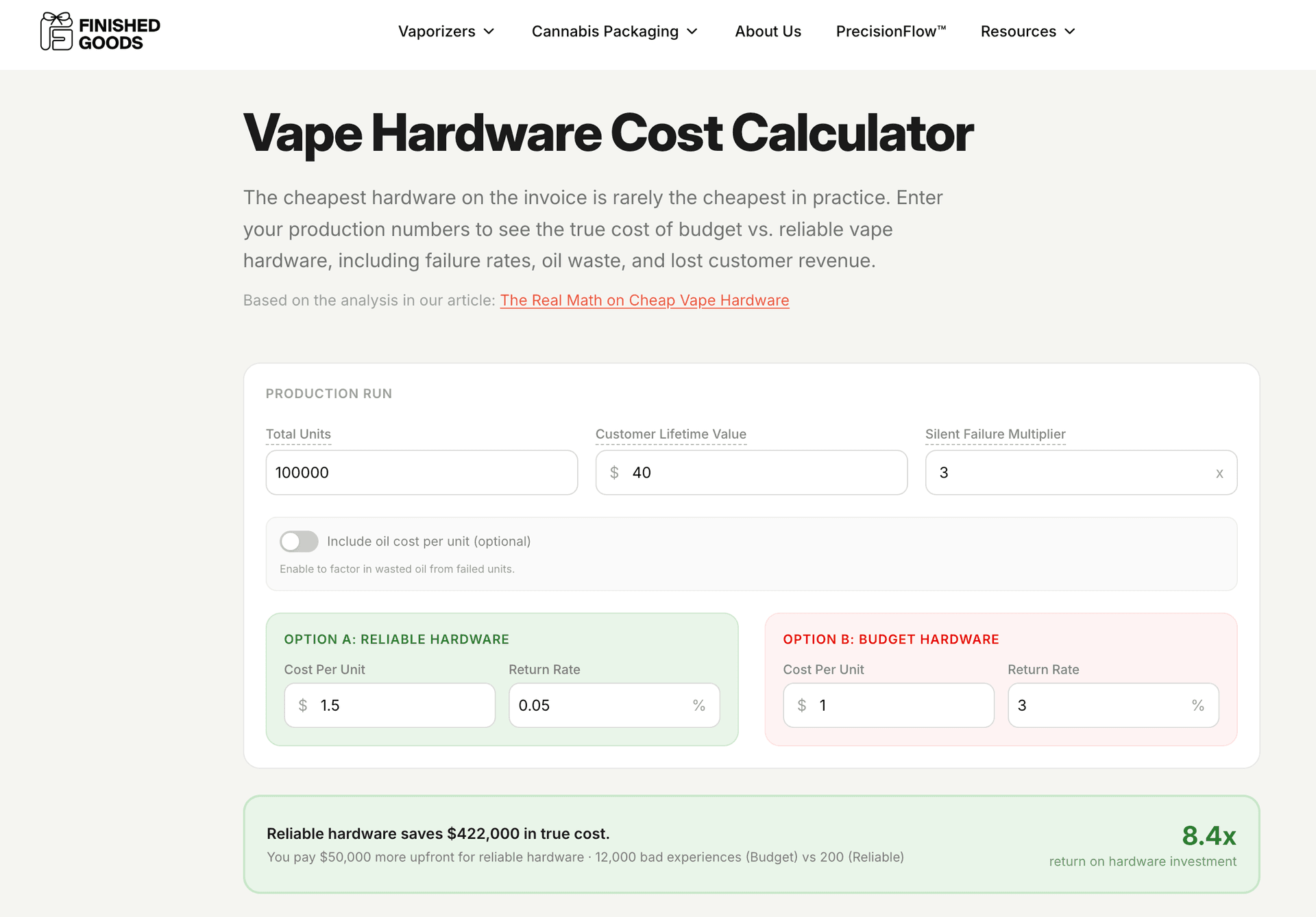
Run the same assumptions through the vape hardware cost calculator to compare unit price, failure exposure, oil loss, and return costs on one model.
Use two equations when comparing suppliers:
- Landed hardware cost per unit = quoted unit price + per-unit freight + duty or tariff + brokerage and inspection allocated across the accepted shipment.
- True cost per sellable unit = landed hardware cost + oil lost to failures + replacement hardware + return processing + rework, divided by the units that remain sellable.
This is why a low factory quote can still be the expensive option. A small unit-price advantage can disappear after tariff exposure, expedited freight, inspection, and a higher failure rate are applied to the same production run.
What is the failure rate gap between budget and premium vape hardware?
Premium suppliers with oil-matched atomizer engineering report return rates below 0.05%, some as low as 0.02%, while budget hardware routinely fails at 1-5% even when marketed as "leak-proof." Hard data on cannabis vape failure rates is scarce because most companies treat defect rates as proprietary, but the numbers that do surface, from industry forums, hardware consultants, and Chinese hardware brokers, tell a consistent story. We break down the published data in our 2026 vape hardware reliability benchmark.
At scale, budget numbers climb. Early samples pass. Pilot runs look clean. Then production ramps and tolerance issues, inconsistent atomizers, and oil mismatch start showing up across the batch. This applies equally to 510 thread cartridges and all-in-ones.
The model below uses 0.05% as a conservative figure for premium hardware; Finished Goods runs at 0.02%. The gap between 0.05% and 3-5% doesn't sound dramatic on its own, but it becomes the dominant variable once you multiply it across a real production run.
At 100,000 units:
- A 0.05% failure rate is 50 units
- A 3% failure rate is 3,000 units
- A 5% rate is 5,000 units
Those aren't just hardware replacements. Every failed vape carries a payload of wasted oil, wasted customer trust, and downstream costs that compound from there.
What does a failed vape actually cost your brand?
A failed vape costs your brand the full COGS of the product twice: the defective unit plus its replacement, and the oil inside is the expensive part. When a cartridge clogs, an all-in-one leaks, or either one burns, the hardware isn't the only loss.
A gram of distillate costs the brand $3-9 at wholesale. Live resin runs $8-15. Rosin is $15-30. The vape that failed? It cost $1.00-1.50.
So a budget cart or all-in-one that leaks destroys $6-30 worth of oil depending on the SKU. That wasted oil is the part of vape hardware costs that finance teams almost never track back to the supplier that caused it.
What does the math look like on a 100,000-unit distillate run?
On a 100,000-unit run at $6/gram oil cost, the $50,000 saved on budget hardware produces $17,700 more in wasted oil alone, before counting a single lost customer.
Budget hardware at $1.00/unit, 3% failure rate:
- Hardware spend: $100,000
- Failed units: 3,000
- Oil lost: $18,000
- Total bad customer experiences (3x silent failure multiplier): 12,000
Reliable hardware at $1.50/unit, 0.05% failure rate:
- Hardware spend: $150,000
- Failed units: 50
- Oil lost: $300
- Total bad customer experiences: 200
And we haven't counted the customers yet.
What hidden cost categories does unit price hide?
Unit price hides three cost categories: oil waste, wasted hardware spend on defective units, and return processing. Run all three against your own production volume before you compare quotes. Using the same 100,000-unit, 3% failure rate budget scenario from above:
Oil-waste cost. Every failed unit takes its fill with it. At $6/gram distillate, those 3,000 failures waste roughly $18,000 in oil. Premium hardware's 50 failures waste $300.
Failure-rate cost. 3,000 defective units at $1.00 each is $3,000 in wasted hardware spend before you even count what was inside them. On premium hardware at 0.05%, that number drops to $75.
Return cost. Each unit that actually gets returned costs $15-35 in track-and-trace documentation, inspection labor, and regulatory-compliant destruction, since returned cannabis product can't be resold in any legal market. At a conservative 10% return-filing rate on 3,000 failures, that's 300 returns, or $4,500-10,500 in processing cost alone, before counting the silent failures that never get filed.
The number that comes out the other side, not the invoice, is what the hardware actually costs.
Why do returns understate your real failure rate?
Returns understate your real failure rate because they only capture the customers who bother to come back, and research consistently shows that for every customer who complains, roughly 26 remain silent. 96% of unhappy customers never file a complaint. 91% of those simply leave and never come back.
In cannabis, the silent departure rate is likely even higher. Most brands have no direct feedback channel to end consumers. The dispensary mediates the entire relationship. A customer who gets a clogged vape is far more likely to quietly switch brands at their next visit than to drive back to the store and process a return.
This is why the silent failure multiplier matters. If 3,000 units come back as returns, there are likely 6,000-12,000 additional failures that never surface in your data. They surface as a gradual, unexplained decline in reorder rates.
Cannabis consumers are already primed to switch. Industry research shows roughly 60% agree that brands don't matter to them, and 80% will choose a similar product from another brand if their preferred one disappoints. Brand loyalty in cannabis is earned one session at a time. A single clog can end it.
How much customer lifetime value does cheap hardware destroy?
In the budget scenario above, cheap hardware destroys $480,000 in lost customer revenue against $8,000 for reliable hardware, even at a deliberately conservative $40 lifetime value per customer. That reframes vape hardware costs as a marketing-budget decision, not a procurement decision.
- Budget hardware scenario: 12,000 bad experiences × $40 = $480,000 in lost customer revenue
- Reliable hardware scenario: 200 bad experiences × $40 = $8,000 in lost customer revenue
The delta is $472,000. To save $50,000 on hardware.
And $40 is deliberately low. Happy Cabbage Analytics, using actual POS data across five retailers over five years, found that a retained cannabis dispensary customer generates approximately $7,000 in revenue over three years. Even isolating the vape-specific portion, a loyal vape customer is worth $1,750-2,100 over three years.
You don't need to use the high number for the math to be damning. Use whatever LTV you want. The ratio stays the same.
What costs does this model still leave out?
The comparison above covers hardware spend, oil waste, and lost customer revenue, and it still leaves out return processing, shelf position risk, negative word of mouth, and compliance exposure.
Return processing. Cannabis returns aren't simple exchanges. Each requires track-and-trace documentation, staff time for inspection and logging, and regulatory-compliant destruction. Returned cannabis products cannot be resold in any legal market. Estimated fully loaded cost: $15-35 per returned unit.
Shelf position risk. Dispensaries deprioritize brands that generate returns. Budtenders stop recommending products that create problems. In a channel where 76% of shoppers say budtender recommendations influence their purchases, losing budtender confidence is a quiet form of delisting.
Negative word of mouth. A dissatisfied customer tells 9-15 people about the experience. 13% tell more than 20 people.
Compliance exposure. In Canada, regulators will actually pull your product off the shelf for hardware-related failures. That's not a hypothetical. It happens.
All of these are real costs. None of them are included in the per-unit hardware price.
Why does cheap vape hardware fail at scale?
Cheap vape hardware fails at scale because it's built to a price point rather than a viscosity profile: generic wicks, uncontrolled alloys, minimal QC, and no oil-specific calibration, with defects that only emerge statistically once production ramps. The price gap between a $1.00 vape and a $1.50 vape reflects real differences in materials, manufacturing controls, and engineering.
Budget vapes use generic ceramic or cotton wicks, uncontrolled alloys, minimal QC, and a one-size-fits-all design with no oil-specific calibration. Whether it's a 510 cartridge or an all-in-one, the failure modes are the same.
Premium hardware uses engineered ceramic formulations, medical-grade stainless steel, multiple QC stages, and oil-specific atomizer matching that tunes intake geometry, wicking rate, and thermal profile to each extract type.
The critical difference: cheap hardware doesn't fail on the sample. Samples are selected to impress. Pilot runs get extra attention. The failures emerge once production scales, when tolerance drift and batch variation across thousands of units reveal the corners that were cut. By then, the product is in consumers' hands.
Different oils behave differently. A distillate with a 5-8% terpene cut flows differently than a live resin. A live resin flows differently than liquid diamonds. An atomizer that works with one will clog, flood, or burn with another. Budget hardware ignores this entirely. That's where clogs, leaks, dry hits, and burned taste originate.
What should you evaluate instead of unit price?
The relevant metric isn't price per unit; it's total cost per successfully consumed unit. Before you compare quotes, put every supplier through the same diligence. We've published a full checklist of questions to ask a vape hardware supplier before you cut a PO, but three matter most:
What is your documented return rate across all customers? Not a best-case number. An average across the full customer base.
Do you match atomizer specifications to oil viscosity? Or is it the same atomizer for every oil type?
What QC stages does every unit pass through before it ships?
If those questions make your current supplier uncomfortable, that's the answer. And you don't need to bet a full production run to find out: a supplier with genuinely low minimums lets you validate real-world failure rates on a small batch first. Our guide to vape cartridge MOQs and why low minimums matter explains how to structure that test.
Use our Vape Hardware Cost Calculator to run the numbers on your own production volumes.
How do you audit your current vape hardware costs?
Pull the last twelve months of purchase orders, return logs, customer service tickets, and dispensary credit memos, then map every unit of cost back to a specific batch of hardware. Most cannabis brands can recover meaningful margin just by re-auditing vape hardware costs across a full production cycle. Patterns emerge fast: certain vendors, certain oil pairings, and certain seasonal temperature swings drive disproportionate failure.
Once you have the data, rebuild your true vape hardware costs as cost per successfully consumed unit, not cost per unit purchased. Layer in oil waste, return processing labor, retailer chargebacks, and the customer lifetime value attached to every silent walkaway. The number that comes out the other side is almost always higher than finance assumed, and it is the only number that should drive supplier decisions going forward.
What is the bottom line on vape hardware costs?
Hardware is 10-20% of a filled vape's total COGS, but it determines whether the other 80-90% (the oil, labor, packaging, compliance testing, and customer acquisition investment) generates revenue or generates returns.
A $0.50 per-unit saving on hardware looks rational on a purchase order. It stops looking rational when a 3% failure rate destroys $3-30 of oil per unit, triggers $15-35 in return processing, and permanently alienates customers worth $40 or more, 96% of whom will never tell you they left.
There is no clean line item on a P&L called "the cost of a customer who never came back." But that line is real, and in the vape category it dwarfs the savings on cheap hardware. Cannabis consumers in mature markets are willing to pay a premium for brands they trust, and they punish brands they don't. Reliability compounds, and so do shortcuts. Vape hardware costs always end up paid in one of two places: in the supplier invoice today, or in lost customers, dispensary chargebacks, and oil waste tomorrow.
For a deeper dive into supplier diligence, see our cannabis vape hardware manufacturer guide. For external benchmarks on category performance, the Headset cannabis market reports remain a useful reference. Brands that measure hardware costs as the sum of every dollar the hardware touches, not the unit price on an invoice, are the ones still growing when the cheap-cart cycle catches up with everyone else.
FAQs About Vape Hardware Costs
What does cart hardware cost per unit?
Budget cart hardware runs around $1.00 per unit and reliable hardware around $1.50 per unit, but unit price is the smallest part of the real cost. At a 3% failure rate, each failed unit also destroys $3-30 of oil depending on the extract, and filed returns cost $15-35 each to process. Compare suppliers on total cost per successfully consumed unit, not the quote on the PO.
What is a good failure rate for cannabis vape hardware?
Suppliers with oil-matched atomizer engineering report return rates below 0.05%, with the best as low as 0.02%. Budget hardware commonly fails at 1-5% at production scale, even when samples and pilot runs look clean. At 100,000 units, that's the difference between 50 failed units and 3,000-5,000.
How do I choose a cannabis vape hardware manufacturer?
Ask every cannabis vape hardware manufacturer for their documented return rate across all customers, whether they match atomizer specs to your oil's viscosity, and what QC stages every unit passes through before shipping. Vague answers on any of the three are disqualifying. Then validate with a small batch before committing to a full production run.
How much oil does a failed cartridge waste?
Each failed cartridge or all-in-one wastes the full fill: $3-9 per gram for distillate, $8-15 for live resin, and $15-30 for rosin at wholesale. On a 100,000-unit distillate run at $6/gram with a 3% failure rate, that's roughly $18,000 in wasted oil, versus about $300 at a 0.05% failure rate.
Do cheap carts really cost more than premium hardware in the long run?
Yes. In the 100,000-unit comparison above, saving $50,000 on hardware produced $17,700 more in wasted oil, $4,500-10,500 in return processing, and roughly $472,000 more in lost customer lifetime value. The savings on the invoice are paid back several times over in failures downstream.
Why do cheap carts pass samples but fail in production?
Samples are selected to impress and pilot runs get extra attention, so cheap hardware rarely fails early. Defects emerge statistically at scale, when tolerance drift and batch variation across thousands of units expose generic wicks, uncontrolled alloys, and the absence of oil-specific calibration. By then the product is already in consumers' hands.