
Air and Air Mini: The First AIO with an Airflow Switch
Meet Air and Air Mini, the first AIO vapes with an adjustable airflow switch. PrecisionFlow technology delivers custom draw, flavor, and clog-free hits.
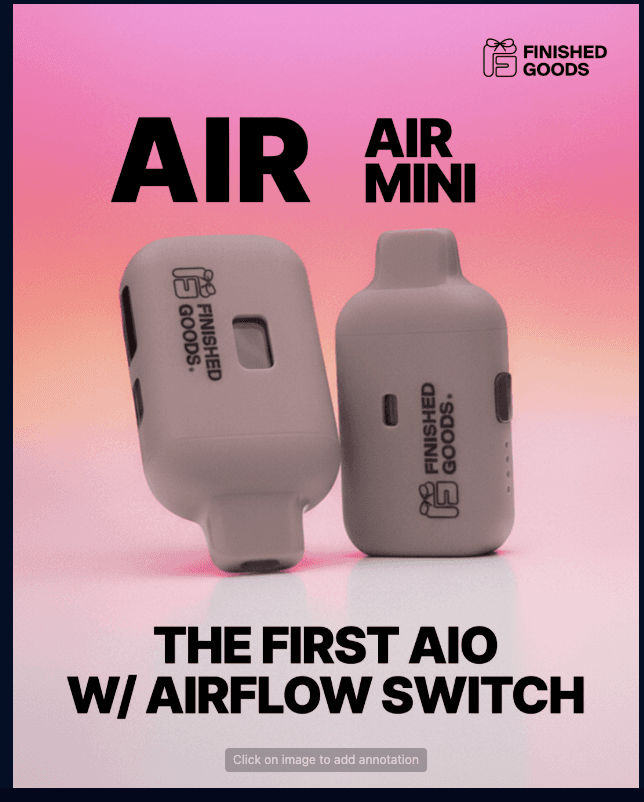
<p>At Finished Goods, hardware isn't about adding features for the sake of specs. It's about removing friction from the experience. That philosophy defines our newest product drop: Air and Air Mini. These are the first <a href="https://www.finishedgoods.com/blog/aio-vs-510-cartridge-which-format-will-dominate-cannabis-in-2026">all-in-one (AIO)</a> cannabis vapes built around an adjustable airflow switch. Together with PrecisionFlow™ Technology, the adjustable airflow switch gives users genuine control over draw resistance, flavor, and consistency across oils, viscosities, and real-world usage. The result is a shift away from rigid, instruction-heavy hardware—and toward intuitive design that adapts to the consumer.</p> <h2>Designed Around PrecisionFlow</h2> <p>At the core of both devices is PrecisionFlow\u2122 Technology, Finished Goods’ airflow-first engineering platform built to optimize vapor path efficiency and consistency. PrecisionFlow\u2122 minimizes common failure points—like clogging, restricted draws, and uneven heating—by allowing airflow and heat to work together rather than compete. The result is a smoother pull, better oil utilization, and a device that performs reliably from first hit to last.</p> <h2>Air Mini</h2> <p>The Air Mini is designed for brands and consumers who want flexibility and performance in a smaller footprint. Supporting 0.5g to 2g fills, Air Mini delivers consistent output without sacrificing control or durability.</p> <p><strong>Key features include:</strong></p> <ul> <li><p><strong>Adjustable airflow switch</strong> for customizable draw resistance</p> </li> <li><p><strong>Adjustable voltage (2.4–3.2V)</strong> to tune flavor, vapor, and temperature</p> </li> <li><p><strong>Precision ceramic atomizer</strong> paired with 316L stainless steel components</p> </li> <li><p><strong>Four-LED indicator system</strong> for clear battery and voltage feedback</p> </li> <li><p><strong>Manufacturing-ready design</strong> with pre-racked tray compatibility</p> </li> </ul> <p>Air Mini is purpose-built to reduce returns, eliminate user confusion, and deliver a reliable experience across a wide range of oil types.</p> <h2>Air</h2> <p>For applications that demand more capacity and deeper session control, Air expands on the same core platform with a larger format and enhanced interface. Supporting 2g to 5g fills, Air is engineered for extended use without performance degradation.</p> <p><strong>Key features include:</strong></p> <ul> <li><p><strong>Large-capacity tank (2g–5g)</strong> designed for consistency over longer sessions</p> </li> <li><p><strong>Adjustable Precision Voltage from 1.8V-4.2V with +/-0.1V, or 3 pre-set voltages</strong> optimized for terpene preservation and efficiency</p> </li> <li><p><strong>User-controlled airflow switch</strong> for personalized draw profiles</p> </li> <li><p><strong>Full LED screen</strong> displaying voltage, battery life, and session data</p> </li> <li><p><strong>Durable internal construction</strong> built for repeated, real-world use</p> </li> <li><p><strong>Automation-friendly design</strong> for streamlined filling and scaling</p> </li> </ul> <p>Air gives users immediate feedback and real agency over their experience—without overwhelming them with unnecessary complexity.</p> <h2>Hardware That Protects the Brand Experience</h2> <p>Air and Air Mini were developed with a clear understanding of where most hardware problems originate: upstream design compromises. Devices that rely on excessive disclaimers, long instruction tags, or “sip don’t rip” guidance are often compensating for avoidable engineering flaws. Finished Goods approaches hardware differently.</p> <p>These devices are designed to:</p> <ul> <li><p><strong>Reduce clogging</strong> and inconsistent pulls</p> </li> <li><p><strong>Minimize customer support issues</strong> and returns</p> </li> <li><p><strong>Deliver consistent performance</strong> across oil viscosities</p> </li> <li><p><strong>Feel intuitive</strong> straight out of the box</p> </li> </ul> <p>When the hardware works, the experience explains itself.</p> <h2>Featured in Beard Bros Media</h2> <p>Air and Air Mini were recently featured by Beard Bros Media, highlighting how adjustable airflow and user-driven control can fundamentally improve the all-in-one vape experience. The article explores how these devices move away from rigid, one-size-fits-all designs and instead give consumers the ability to dial in their preferred session—without relying on workarounds or instructions to compensate for poor hardware.</p> <h2>Why an Adjustable Airflow Switch Matters</h2> <p>Most all-in-one vapes ship with a fixed airflow path. The factory picks one draw resistance and every consumer lives with it. That's a problem because users don't all want the same pull. Some prefer a tight, restrictive draw closer to a traditional cartridge. Others want an open, free-flowing hit that mimics a session pipe. A fixed airflow path forces a compromise that nobody actually chose.</p> <p>An adjustable airflow switch removes that compromise. With a single physical control, the user dials in a draw that fits their preference and their oil. Tighter airflow concentrates vapor and emphasizes flavor at lower temperatures. Looser airflow cools the pull and increases visible vapor. Neither setting is wrong. They're simply different sessions, and consumers should be allowed to choose.</p> <p>There's also a hardware-engineering reason to favor an adjustable airflow switch. Different oils behave differently inside the same atomizer. A high-terpene live resin flows more freely than a heavy distillate. A liquid diamond extract sits somewhere in between. When the airflow path is fixed, brands have to pick which oil class they're optimizing for and accept clogs, dry hits, or floods on the others. An adjustable airflow switch lets the same device serve a much wider range of formulations without re-engineering.</p> <h2>Built for Multiple Oil Viscosities</h2> <p>PrecisionFlow Technology pairs the adjustable airflow switch with a precision ceramic atomizer and 316L stainless steel internals. The combination is what allows Air and Air Mini to perform consistently across distillate, live resin, rosin, and liquid diamond formulations. The ceramic wicks at a controlled rate. The stainless components hold tolerances under heat. The airflow switch tunes how much air meets the oil in the heating chamber.</p> <p>For thicker oils, a tighter airflow setting keeps vapor density up and prevents the cool-down that causes dry hits. For thinner, terpene-rich extracts, a more open airflow setting reduces flooding and protects the wick from saturation. The user gets to make that call session by session. Brands get a single SKU that works across their full menu instead of three different devices for three different oil profiles.</p> <h2>Choosing Between Air and Air Mini</h2> <p>Both devices share the same core platform: PrecisionFlow Technology, a precision ceramic atomizer, 316L stainless steel construction, and an adjustable airflow switch. The decision between them comes down to fill capacity, voltage range, and the kind of session your customers want.</p> <p>Air Mini is the right pick for brands that want a smaller-format AIO with broad oil compatibility. The 0.5g–2g fill range matches most pre-roll-adjacent SKUs and impulse-purchase price points. Adjustable voltage from 2.4V to 3.2V covers the meaningful range for distillate and live resin without overcomplicating the user experience. The four-LED indicator gives clear feedback without a screen the consumer has to learn.</p> <p>Air is the larger sibling, built for connoisseur-tier SKUs and longer session use. The 2g–5g tank supports premium live rosin and liquid diamonds where a higher fill weight is part of the value proposition. Adjustable voltage from 1.8V to 4.2V (with ±0.1V granularity, or three preset modes) gives users meaningful control over flavor versus vapor. The full LED screen shows voltage, battery, and session data so the consumer always knows where they stand. For brands targeting a more deliberate, premium experience, Air is the device that earns the price tag.</p> <h2>Frequently Asked Questions</h2> <h3>What makes the adjustable airflow switch on Air and Air Mini different?</h3> <p>Most AIO devices use a fixed airflow path that's set at the factory and can't be changed. Air and Air Mini build the airflow control directly into the device. The user moves a single physical switch to tighten or loosen the draw. That choice changes how the oil heats, how vapor density develops, and how flavor reads on the palate. It's a hardware-level customization, not a software trick or a marketing label.</p> <h3>Which oil types are Air and Air Mini compatible with?</h3> <p>Both devices are designed to perform across a wide range of cannabis oil formulations: distillate, live resin, live rosin, and liquid diamond extracts. The combination of the precision ceramic atomizer, <a href="https://www.finishedgoods.com/blog/510-thread-battery-voltage-guide-how-power-affects-cartridge-performance">adjustable voltage</a>, and the adjustable airflow switch lets the same device handle thicker and thinner oils without re-engineering. For brands with a <a href="https://www.finishedgoods.com/blog/dual-tank-vape-pens-new-category">multi-format menu</a>, that means one hardware platform across SKUs instead of three.</p> <h3>Does the adjustable airflow switch help <a href="https://www.finishedgoods.com/blog/zero-clog-vape-hardware-2025-year-in-review">reduce clogging</a>?</h3> <p>Yes. Clogging usually starts when airflow and oil viscosity are mismatched. The airflow path is too restrictive for the oil, condensate builds up in the wick, and the device chokes itself. The adjustable airflow switch lets the user open the path enough to keep vapor moving through the chamber. Combined with PrecisionFlow Technology and the precision ceramic atomizer, it removes the most common conditions that lead to clogs in traditional AIO hardware.</p> <h3>Are Air and Air Mini ready for high-volume manufacturing?</h3> <p>Yes. Air Mini was designed with manufacturing-ready geometry and pre-racked tray compatibility, which lets fillers move from <a href="https://www.finishedgoods.com/blog/vape-pen-sample-station">sample run</a> to scaled production without retooling. Air carries the same automation-friendly construction in a larger format. Brands looking to standardize on a single AIO platform can consolidate their hardware spend without sacrificing format flexibility at retail.</p> <h3>How does an adjustable airflow switch improve the consumer experience?</h3> <p>It puts session control back in the hands of the user. Some consumers want a tight, restrictive draw that produces a concentrated, flavor-forward hit. Others prefer an open pull with cooler, more visible vapor. The adjustable airflow switch lets the same device serve both preferences without a different SKU. That single hardware feature reduces returns, support tickets, and the kind of silent dissatisfaction that quietly erodes brand loyalty.</p> <h2>The Bottom Line</h2> <p>An adjustable airflow switch is a small piece of hardware with a large impact on the all-in-one experience. It gives consumers a real choice instead of a pre-set compromise. It lets brands ship a single device across a wider range of oils. It removes a category of common failures that drive returns and quietly burn customer loyalty. Air and Air Mini bring that capability to the AIO market with the engineering depth of PrecisionFlow Technology behind it.</p> <p>For brand operators evaluating their next hardware platform, the question worth asking is no longer just "What does this device cost per unit?" The better question is "What does this device cost when it works, and what does it cost when it doesn't?" An adjustable airflow switch tilts that math in the right direction. The hardware adapts to the consumer instead of the other way around, and the brand experience holds together from first hit to last.</p>